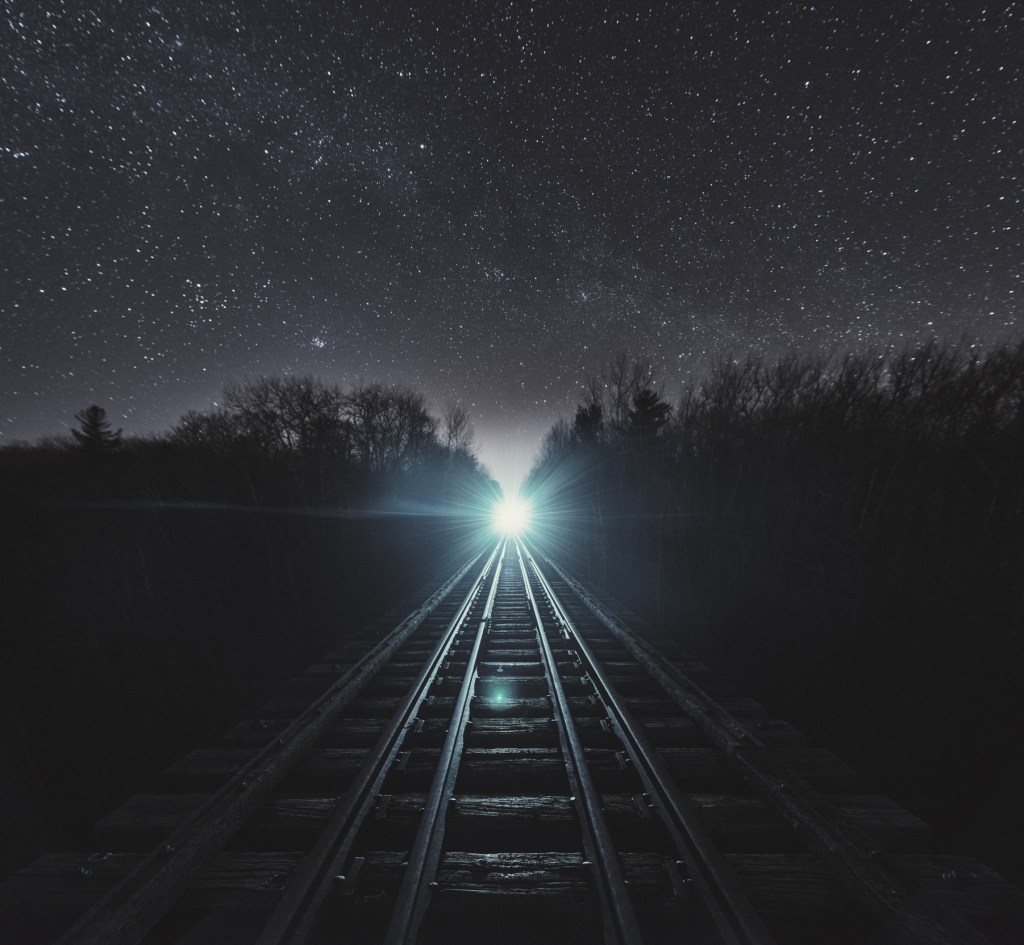
Riding the Rails is about the Journey

There is something about the sound of a train whistle at night that fuels my imagination. Even today, when I am up early and hear a passenger train moving past my home in Camden, SC. I wonder about the people on-board and where they might be going. I remember as a kid, walking along tracks in Minnesota, and trying to imagine where they ended.  

The train’s, the Silver Star and Silver Meteor that runs from NY to Miami conjures up images of stream-line trains moving through the night against the backdrop of millions of stars emitting a silvery light. 

Despite my fascination with trains, I didn’t take my first official trip on the rails until later in life. I remember standing on the platform at 3:00 AM at Columbia Station, waiting for the train that would take me to Tampa, Florida. The platform, a hundred feet or so long, had a pitched roof supported by metal poles and lamps spaced every dozen feet illuminating small pools of light along its length.

When the train arrived, it rolled in quietly, the only sound from its metal wheels emitting a scraping sound against the rails. The city, asleep, with its darkened neighborhoods and shuttered businesses, never noticed its arrival or departure.

Once settled in my seat, sleep was the furthest thing from my mind; I wanted to see Columbia from this new perspective, and was frustrated by the darkness of a moonless night. I was only able to guess at the general area in which we traveled, and it was two long hours before dawn unveiled the passing countryside.  

Leaving my seat to find the dining car, I passed sleeping passengers along the way. In the space between cars, you get a better sense of movement as the small walkways mimic fluctuations in the rails, and without insulated walls, the sound of rushing air unmuted.

 The dining car, empty of passengers when I arrived, consisted of a small counter where a railroad employee busied himself with stocking the shelves. Purchasing a sweet roll and coffee, I sat in the deserted car watching an orange-red sunrise, its fiery coloration promising steamy temperatures for the day.

It was interesting to see small towns along the route. It would seem efforts to make a first impression focused mainly on car travel—the train route, offering a different view, where the sins of too much stuff were piled unceremoniously behind businesses. The dumping of trash along the tracks near towns contributed to a feeling of decline.

When stopping to pick up new passengers, smokers stepped down from their cars and huddled near the tracks feeding their addiction.

Arriving in Tampa, the engineer performed a lengthy backing maneuver into the station. The Tampa Station house beautifully restored fit perfectly into the old cigar district of Ybor City.

My daughter, her husband, and grandson who picked me up, questioned the sanity of spending an additional three hours traveling by rail as opposed to driving, and as I left the station, glancing down the tracks I had yet to travel, I couldn’t help wondering where they might go.  

Blind Tragedy

MacDill Air Force Base in Tampa, Florida, was my first tour of duty after enlisting in the military in 1976. When I arrived on the base, one of the first things I noticed was the tropical climate and how different it was from where I grew up in Minneapolis. One intriguing feature was the clocklike precision of afternoon thunderstorms. From the Flightline, you could watch the wall of rain sweep down two miles of runways and across the sea of asphalt, which made up the Flightline. The resulting humidity and steam arising from the previously scorching tarmac once the storm passed was quite oppressive. The rain itself was different from anything I experienced in Minnesota. The volume of water that fell was astounding even though the downpours were short-lived.

MacDill AFB occupies the southern tip of the Tampa Bay Penisula, and the water surrounding it consists of Tampa Bay, Old Tampa Bay, and Hillsborough Bay.  

In the spring of 1980, I was working the graveyard shift. Our crew’s job was to ensure the fighter jets weapons systems were operational for the next days bombing runs to Avon Park. MacDill, a pilot training base at the time, practiced dropping all types of ordinances in a controlled setting.

I lived about a mile off-base from the main gate and traveled each night to my job by bicycle. Once I cleared the main artery for cars, I would cut over to the FlightLine and follow the service vehicle route, which skirted the edge of the tarmac. My shift started at midnight on May 8, 1980, and it was a typical night with high humidity, warm breezes, and the smell of salt air and jet fuel. As the shift started, the calendar turned, and it was now the early morning of May 9th.

The work we did that night was the same as every other night. Our four-person crew made sure that the jets scheduled to fly in the morning, were properly configured with the missiles and bombs required for the next days training mission. We normally completed our tasks by 5:30 AM and then waited for the dayshift to relieve our crew. It is unusual to get rain at night, and once the afternoon showers rolled through around 4:30 PM, the rest of the day and night tended to remain calm. The following day the heat would start to rebuild the thunderheads. During the night, we could see what the locals referred to as heat lightning. The flashes of lightning deep inside cloud formations appeared in the distance over Gulf, and seldom had any effect on our weather at the base.

At 5:43 AM on the morning of May 9 in the Gulf of Mexico, the 609 foot 34,000-ton Summit Venture, raised anchor and headed for the entrance to Tampa Bay.

At 6:30 AM, the National Weather Service in Ruskin Florida reported a line of intense thunderstorms 65 nautical miles west of Tampa Bay. The line which had developed out of a moist tropical air mass was moving at nearly 40 miles per hour toward the east.

At 7:15 AM, with my shift nearly completed, I saw the weather rapidly deteriorating around me. It was not like the approach of a normal storm with a flash of lightning followed by a rumble of thunder every few seconds. This storm had lightning resembling a laser show and a continuous rumble of thunder growing louder as it rolled maliciously toward us.                                                                                                                                             

7:25 AM, the Summit Venture was starting its approach toward the Skyway Bridge that connects St Petersburg to Bradenton as part of Interstate 275. The severity of the sudden storm completely blinded the crew of the Summit Venture with winds estimated between 60 and 70 mph, and a falling rain volume equivalent to 7 inches per hour.

7:31 AM, the Summit Venture’s pilot, gets his first visual of the bridge and immediately realizes he is no longer in the shipping channel. The pilot issues a series of commands for evasive measures.

7:34 AM, the Summit Venture collides with the Skyway bridge, and 1297 feet of the roadway falls 150 feet into the water below. Eight vehicles, including a Greyhound bus, unaware of the collapse and traveling with limited visibility drive off the end of the remaining roadway. Within minutes 35 people have lost their lives in the accident.

7:42 AM, the wind from the storm on-base reaches nearly 40 mph, and the rain fell in a volume that I had never witnessed before or since. Having been caught temporarily outside in the onslaught, I found it difficult to catch my breath with the sheer amount of water pouring over me.  

The storm cleared the base and moved to the east by 8:15 AM. The mighty deluge of rainfall had no place to go on a base with only a few feet of elevation. The Flightline, service roads, infields were all flooded with six or more inches of standing water. And what normally was a sea of pavement, now looked like a massive shallow lake.

Riding my bike home that morning was difficult through the standing water. It was not until I arrived that I learned of the Skyway Bridge disaster. After witnessing the storm on the base, I could easily imagine the difficulty the crew must have faced in trying to navigate the large ship through the binding storm.