May 5, 2020.
The sound of a door hitting the frame on an abandoned shack from wind sweeping through the valley is lost in desolation. The tiny building’s floor, littered with old whiskey bottles, empty food cans, and rusted tools, provides a window into its past inhabitants. Sonny Chance sits on a weathered piece of wood, once a part of the shacks cladding, now balanced between two rusty pails. Staring at the floor, he watches a shaft of light that widens and narrows in sync with the swaying door, blue smoke curls around his prematurely weathered skin.
In quiet times, voices and faces of disappointment haunt him. He no longer has the stomach to look at the destruction in the wake of his compulsion: a failed marriage, lost career, and financial free-fall.
Three years ago, Sonny succumbed to a fever inflicted on treasure hunters, the kind of fever that gets under your skin and won’t let go. He found a hand-carved walking stick mixed in with cheap umbrellas at a yard sale in Minneapolis, and the item turned out to be old. Experts at the University of Minnesota believed the carvings to be the work of the Lakota Sioux. During their examination, they discovered something else, something that would forever change the course of his life.
Running his fingers along the body of the intricately carved stick now, he slides it apart, revealing the hollowed-out portion containing his obsession. Removing the thin animal hide from the compartment, he unrolls it for the thousandth time. The soft leather stained with plant-based pigments renders its image in muted tones. The scene of a large meadow in the foreground of purples and browns slopes sharply toward a distinctive rock outcropping. Above the ridgeline, the sky in pale gradients of whites, yellows, and blues is indicative of a setting sun. Four words in Lakota are written near the bottom, “Place of yellow metal.”
In the 1870s, a gold rush brought thousands of prospectors to the Black Hills of South Dakota, even though the Laramie Treaty of 1868 recognized the land as part of the Great Sioux Reservation. To the prospectors, the treaty was an inconvenience, an obstacle, in the way of riches that most chose to ignore. There are reports of missionaries as early as the 1850s who witnessed Indians carrying gold that they claimed had come from the Black Hills. Sonny believes his artifact dates to those earlier years.
Being the first week of May, mornings in the Black Hills can still be near freezing, and Sonny, starting early, has searched for several hours by mid-morning. He uses old trail maps and a compass for navigation, no longer owning a cell phone. He estimates his location somewhere between eight and ten miles west of Crazy Horse.
Following the banks of Loues Creek, he sees the side of an outcropping on a high hill in the distance. Leaving the creek bank, he angles through the pine forest in the direction of its base. According to his compass, the outcropping faces east, which he believes is a prerequisite for the location of the painting. He finds the shack at the bottom of a smaller hill in the valley between his destination. The place looks like an old mining operation with abandoned narrow rail beds for hauling rock.
Sonny, essentially homeless, carries his possessions inside a large backpack, the type you see thru-hikers use on the Appalachian Trail. When food and tobacco run low, he picks up odd jobs in the small towns that dot the Black Hills until he can resupply. Adept at living in a tent, he treks through the seemingly endless hills searching for the location of the painting. His lifestyle works in the summer months, but winters in these parts are not survivable outdoors. He awkwardly spent the past winter in his daughter’s house basement in Minneapolis but is confident she isn’t inviting him back.
Seeing potential in the shack as a home base, he figures by traveling lighter; he could cover more ground. He estimates it is another mile or so to the front of the outcropping and, taking out his flashlight and a fresh pack of smokes, slides the backpack and cane behind an old workbench against a sidewall.
Back outside, he breathes in the fresh scent of pine forest floors warmed by the afternoon sun. Wildflowers are flourishing in sunny patches along the tree line, and insects are moving as if making up for lost time. Everything around him is coming to life after the long winter.
Navigating through the valley is easy in the flat land meadows with a sparse cover of trees. Looking up periodically, he sees the rock face set against a perfect blue sky, revealing itself slowly the further he travels to the northeast. Cutting over to the hill’s base, he starts up the incline at an angle, gaining elevation while still working toward its facing side. The forest’s density returns on the hillside, and he can no longer see the rock outcropping through the canopy.
With the steeper incline, he grabs pine branches and exposed roots as handholds to pull himself along; the millions of needles create a slippery surface. The light under the canopy is dim, except for a few shafts of light that have pierced small openings.
Abandoning the angled approach, he now climbs straight ahead, and several hundred feet above him, there is a stark brightness along the entire width of the treeline. Approaching closer, it looks as if the trees abruptly end, with the land opening up beyond.
For Sonny, reaching the line and stepping into the sunlight is like stepping inside his painting. A wave of excitement washes over him as he realizes everything is in its place. The tall grasses infused with thousands of indigenous Darkthroat Shooting Stars render the meadow in a purple hue. The outcropping reminds him of a skeleton key with two higher columns like bookends, holding a jagged set of smaller peaks. With the sun still above the ridgeline, it is not hard for him to imagine a pale pastel-colored sky when it sets.
Sonny crossing the meadow to the base of the rock, places his hand on the cool surface of the granite. Slowly walking the width of the rock base, he runs his hand inside small crevices and inspects the rock for signs of shiny metal. Standing in the majesty of the place, he feels connected to its history.
Not finding anything, Sonny takes a breather on a ledge between one of the broader crevices forming a deep V into the rock. There is a young pine tree seemingly growing directly out of the rock wall inside the V, its exposed roots clinging to the tiniest of cracks for survival. Firing up a smoke, he looks out at the expansive view of the valley and beyond.
Standing up, Sonny looks back into the deep V and blows a stream of smoke from the last drag of his cigarette. The smoke floats leisurely in the still air and suddenly rises rapidly. Sonny squeezing into the crevice, feels a cool updraft coming from the rock floor. Crawling on his hands and knees, he shifts loose rock around, and the stream of air increases. Using one of the loose rocks as a bludgeon, he enlarges an opening to a point where he could slip through. Shining his light in the hole, he sees a workable pitched surface descending to the cave’s floor. With the butt end of his flashlight, he prods the exposed earth below the removed stones and can hear the echo of dirt falling within a chamber below.
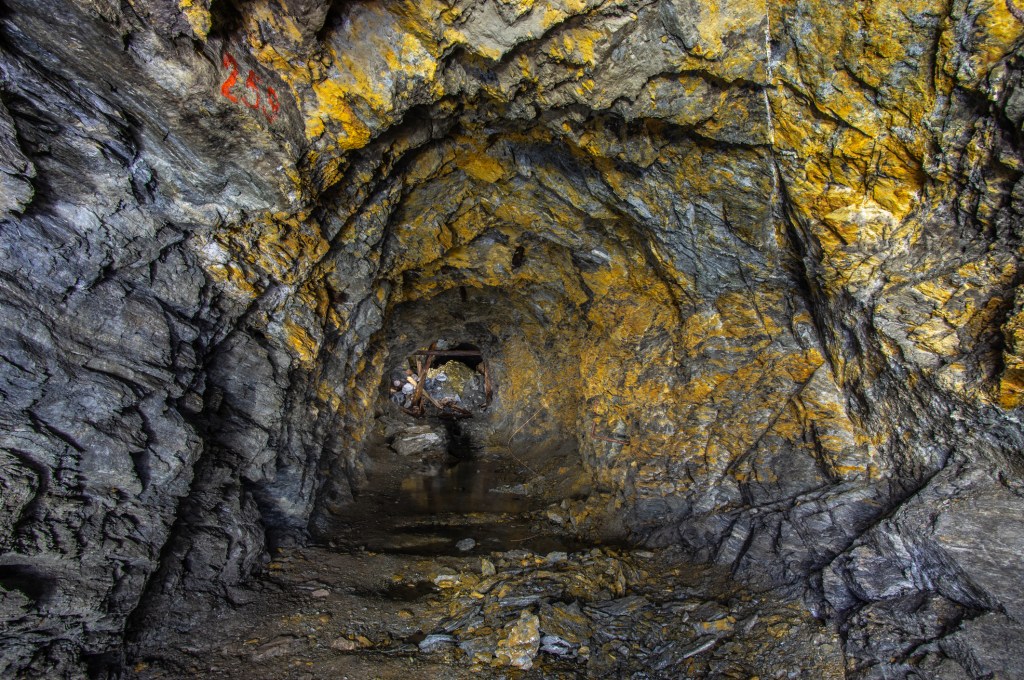
Sonny knows the dangers involved with cave exploration, but the excitement of the discovery overrides his usual caution. Slipping through the opening, he turns on his light, half scrambles, and half slides his way to the cave’s floor. Shining his light around the bowl-shaped space, he sees flashes of exposed gold everywhere, like someone took a brush and started flinging gold paint. The chamber, probably once a raging river, was cut into a U shape as the water channel around the curve wore the walls smooth.
Walking along the inner wall, Sonny reached up and started tracing a vein that varied in width from four inches to over a foot thick. Training his flashlight on the mesmerizing color, he follows the wall’s curvature, trying to imagine the value of what he was seeing.
He realizes that he has made a fatal mistake in a fraction of a second. Like slipping on black ice where one finds themselves on the ground before they even know they have slipped, Sonny’s next step is met with only air, catching him completely off balance. Sonny grasps the emptiness before him as he falls into an unknown void. The spinning beam of his flashlight flung from his hands in desperation is the last image he sees before total blackness.
Sonny did not know how far he fell, but it didn’t matter; landing on jagged rocks, he was broken in many places and understood he had found his final resting place.
Nov 30, 2020.
Black Hills Chronicle
From Rapid City, SD, David Tillis was searching for the opening of the Loues Creek mine in a remote area west of Crazy Horse when he discovered an old Lakota carved walking stick in an abandoned shack. The carved stick had a secret compartment containing a rare leather painting. Experts authenticated the artifacts dating to the mid-1800s, and a NY auction company hired to sell the lot has set a reserve of 1.2 million dollars.


 Joseph Benedict Blog