Wrecked

I was lying in bed, listening to the rain drumming against the metal roof of the old barn. It was not the sustained kind from clouds; this downpour was created by an overhanging oak branch and lingering wind from an earlier storm.  

I suffer from a condition known as sleep apnea, where my breathing stops and starts abruptly while asleep. Since my recurring dream started several weeks ago, I have been awakened each night, gasping for breath at the same point.  

In the dream, confused waves batter me from every direction, and when riding high on a swell, I can see massive wooden objects floating near—the broken pieces looking like parts of an old sailing ship.  

The sky is a contradiction of angry storm clouds pressed low with shafts of light penetrating openings at higher elevations. The light illuminates a large wave above me, rendering its peak a translucent blue-green, its beauty in stark contrast to the tempest that grips me from below. 

Something vast and dark looms in the distance, and sharp voices yell indistinguishable words swept away in the wind. The icy water pulls me down, trying to swallow me, and I struggle to keep my head above its slippery surface. In the troughs with swells mounding above me, I sense the hopelessness of my predicament. Forced underwater by a cresting wave, I see a shaft of sunlight slicing downward, disappearing into the abyss. The surface moves away from me, leaving only the silence and darkness of an unknown world below.   

Then I wake up, and reality rushes in to reclaim my conscious state, pushing the dream into the recesses of my mind.  

I rolled onto my side and saw the flat comforter and neatly aligned pillows where my wife Michelle usually lies, her undisturbed side of the bed was colored in layers of gray in the dim morning light.  

She had left the day before on a company trip to Canada; their training was scheduled on the weekend so that all the managers were not absent from weekday operations. Her departure was not what I had hoped for, and her expression increased the hollow feeling in my stomach when she left. 


 XXX                                    

The rain had brought a steep drop in temperature, and I felt the cold seeping into the barn – spreading itself low along the floorboards, puddling in corners, and anywhere loose-fitting enclosures provided an opportunity. We chose to leave the ceiling open with exposed rafters when renovating the structure. The design looked impressive and worked in warmer months but had proven difficult to heat during northern Maine winters.   

I had hoped for an extended autumn, but the mercury that hovered just above 40 degrees outside the kitchen window promised darker days ahead. 

A copper container used for holding split logs still held several pieces from the previous winter, and not yet willing to surrender to the idea that the season was over, I had built a fire rather than turning on the furnace for the first time.  

During a weekend trip to Vermont, we had purchased the wood-burning stove from a craftsman; its exterior was covered in polished soapstone and radiated an even warmth for hours when heated. The well-seasoned wood caught quickly, and the fire’s yellow flames reflected across the kitchen floor—the light and smell of burning wood cheered up the room. 

There were items strewn about the house like breadcrumbs from Michell’s departure. Empty hangers on her nightstand, a small suitcase pulled from her closet, and then abandoned, brightly colored new clothes tags with matching-colored strings discarded in the bathroom wastebasket, house shoes with collapsed backs tossed in the entry, and a half cup of coffee sitting near the edge of the kitchen island.   

XXX                                                 

A week before Michelle’s training, I attended her company’s dinner party, and the scenes from the night had played on a continuous loop that I watched for the thousandth time.

The drive had been mostly quiet. The winding secondary highway took us through familiar villages where we had once hunted antiques and dined in local restaurants. When the sun dropped below the tree line, it produced a strobe effect like an old movie, only this light was a soft golden hue, and as I glanced at Michelle, I imagined her as a beautiful actress in her black dress and a simple string of pearls.
 

I turned off the secondary road onto a freshly paved private lane that brought us to the entrance of the Watkins estate. Tiered gardens flanked the intricately forged iron gates that had been left open. The road, shaded by forest, continued for another mile beyond the gates ending in an open space that revealed an ultra-modern home built of glass, metal, and exotic-looking wood. Its unusual design and severe angles looked like a ship had been moored in the middle of the forest.

“Try to have a good time tonight,” Michelle said as we walked from the car toward the entrance.

I looked at her with an expression of mock surprise.

Bruno Watkins, the host, met us at the door and seemed pleased to see us, or at least Michelle. “Welcome, welcome; thank you for coming,” 

“Oh, I thought it was required,” Michelle said with a smile. Then, with a motion like a game show model, she announced, “this is my husband, Jack.”

Without waiting for a formal greeting, I said, “Bruno, your home makes such an architectural statement, and it’s blended so well with its surroundings.”

“I like your husband,” he said, looking at Michelle.

Michelle nodded with a look of approval.

“So, Jack, since you understand good design, would you like to see the place?”

“Love to.”

Michelle left us to it and wandered off to join a group gathered around an open bar run by the catering company.

“What do you do?” Bruno asked.

“I am a technical writer; a lonely pursuit, not much of a conversation starter, and has little or no job satisfaction, but other than that, it’s great.”

Bruno laughed and nodded that he understood. After seeing the home, we ended up at the top of the main staircase overlooking the party.

“Go join the festivities,” Bruno said; I will be down shortly.

As I descended the stairs mostly unnoticed, I spotted Michelle in a small group on the far side of the room; she was checked out of the conversation and was gazing across the room with an intimately familiar expression.

As I watched her, voices in the room merged into an undistinguishable hum, and objects and people around me blurred until she was the only person I saw. The moment’s intimacy shattered when she saw me approaching; she looked confused and unsure.

XXX                                                 

The barn felt claustrophobic, and I needed a distraction. There was an exhibition at the museum of art in the city that had started on Friday—promising beautiful Landscapes by Dutch Masters of the 17th century.   

When I arrived in the early afternoon, the downtown was mostly devoid of people, with most restaurants and shops open only on weekdays when offices were filled with workers.

The temperature downtown hovered near 40, and the wind out of the north gave the day a raw feel. Wet leaves pressed flat against the street, and sidewalks held fast in the frequent gusts. Thick gray clouds cast a weak light that drained the city of its color, unifying it in a drab sameness.    

The exhibition had attracted a small crowd, and I saw couples and groups standing inside the expansive lobby. The glass exterior of the museum, brightly lit from within, was the only inviting oasis in an otherwise abandoned-looking city. I was soon able to lose myself in the calming pastoral scenes and, for a short while, found relief from the anxiety that plagued my waking hours. The exhibition was smaller than I had hoped, and I finished in less than an hour.

The exhibition admission included entry into the museum’s permanent collection, and though I had been through it in the past, I was in no hurry to leave. 

The permanent collection housed on the second floor consisted of a dozen rooms with offset entry and exits, giving the space the feel of a maze. I could hear people’s voices in the rooms; the nonstructural walls open at the top allowed sound to travel throughout, but I never crossed paths with anyone as I walked between exhibits.  

Turning left out of a room filled with large abstract art, I entered a long hallway that doubled as a gallery for sculptures. The length of the space provided a conduit to five other rooms, two on either side and one at the opposite end.

Each gallery, controlled by motion detectors, switched overhead lights on when visitors entered; the task lights on the artwork always remained on. The painting with the backdrop of a darkened room at the end of the hallway looked like a lighted screen from a distance. The oil on canvas image was of a large seascape I couldn’t remember ever seeing before. As I approached, the intricately carved frame covered in gold leaf shimmered in its brilliance. Mesmerized, I felt its magnetic pull. 

Trance-like, I could not avert my eyes from the curving swirl of the brush strokes; the scene seemed animated, conveying a sense of tragedy and beauty.  Standing only inches from the painting filled my peripheral vision, and I could nearly smell the salt air and hear the panicked voices. Small wooden fishing boats with rescuers looked dangerously close to wrecking against the jagged shoreline in the rough seas.

Remnants of a broken ship were barely visible in the shadows of the high cliffs, large mast pieces floated in the foreground, and gulls swooped low near the wave’s crests. The mountainous terrain behind the small fishing village soared to great heights; its ruggedness spoke of the island’s desolation. 

 Slowly the painting revealed itself to me, and as I stared into its commotion, I realized that revelation was my dream. The towering mountain of rock, the dark object I could not make out beyond the low clouds, the sharp voices of men in fishing boats attempting a rescue. I believe if it were possible to widen the view, I would have found a sailor struggling to survive near the frame’s bottom edge.  

XXX

The temperature had been falling steadily since mid-afternoon; I could see the barn, which sat on a slight ridge from a distance and looked dark and unwelcoming in the failing light. The waist-high cord grass in the fields rolled like waves pushed by the wind out of the north.

I turned onto the gravel road that served as an easement for the original farmhouse and saw Tom, the owner, walking back from the mailbox. Tom was an awkward man in his late sixties who lived alone and would be the last person in his family to own the land that had been passed down for generations. He had no interest in farming and planned to subdivide the 300 acres and sell it to developers.

Easing the car alongside him, I lowered the passenger window and called, “Hey, Tom.”

Tom, a tall man, placed a hand on the car’s roof and stooped down so he could see me. “Hello, Jack; looks like we’re in for some weather.”

“Yeah? I have been out of the loop; what are they saying?”

“Supposed to get pretty nasty tonight, and through most of tomorrow, lots of wind and rain, maybe snow.” Tom looked up at the clouds after the mention of snow as if taking his own reading on the matter. He looked back at me and asked, “Where’s the missus? Haven’t seen her around much.”

“Her job has been keeping her late; it’s usually dark when she gets home most days.” It didn’t sound convincing when I heard it out loud. “She’s up in St. John this weekend for training,” I added, feeling an additional need to justify her absence.

 “St. John, huh? Tom looked concerned, “the storm will be whipping up that bay; They’ll probably shut down the ferries; I wouldn’t want to be on that water in a storm.” He said mostly to himself. Then as an afterthought, he said, “You should check your generator; power will probably go out before the night is over.”

“Thanks, I will,” I said as I lifted the brake slightly and heard the crunch of gravel as the car inched forward.

 Tom slapped the roof twice to let me know I was good to go.

Inside, I turned the thermostat to heat and could smell the burnt dust that had accumulated on the unit in the off-season. I stirred the ashes in the wood-burning stove in the kitchen for signs of life, but the earlier fire had gone cold.

Outside the back door, I opened the small wooden enclosure that housed the generator and looked the unit over. I had no idea how to tell if it was working or not; it had always just come on whenever we lost power.

       XXX                                           

My office was dark, except for a small pool of white light illuminating my laptop. I turned the wall-mounted TV to the weather channel and set the volume to low. After several other segments, the station shifted to a map of the eastern US, where a nor’easter was bearing down. It was a vast area that included New Brunswick, Nova Scotia, The Bay of Fundy, New Hampshire, and Maine. The weatherman said the system was early for the season and that people in its path could expect gale-force winds, freezing rain, and significant snowfall depending on their location.

I found historical text about the oil painting from a Google search. I had made a mental note of the artist, Edward Moran, from a small brass plate attached to the frame. The painting was titled “Grand Manan” and was dated 1859.  
 

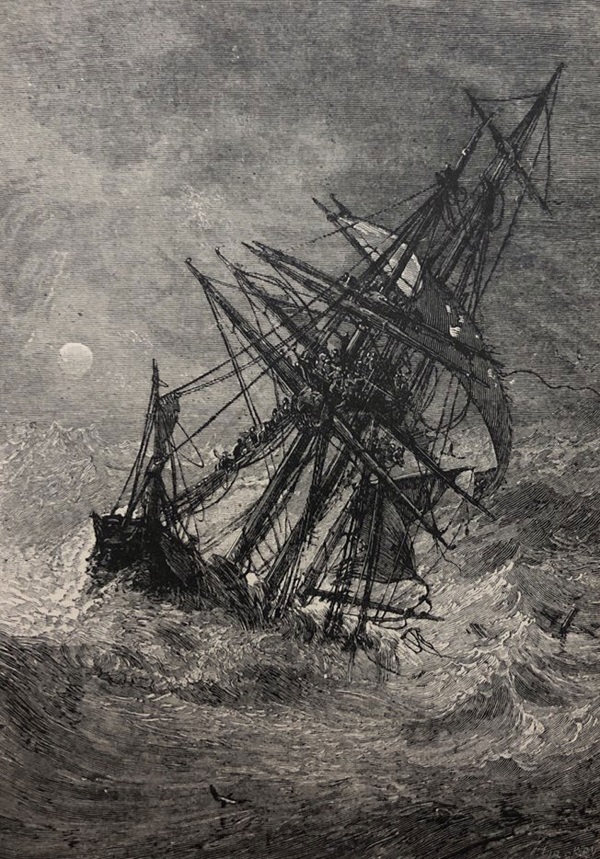
Art historians believe the subject to be the wreck of Lord Ashburton, a three-masted sailing ship trying to reach the port of St. John. A violent nor’easter had blown it back down the Bay of Fundy, where it wrecked against the jagged shoreline of Grand Manan Island during the winter of 1857. All three masts were carried away in heavy seas as the ship broke up on the rocks. The captain and most of the crew of 28 men drowned. Of the ten that reached the island, two froze to death at night before villagers could mount a rescue in the morning.

                   XXX                               

It was around 7:30 PM when the power went out, and as if to validate Tom’s concern, the generator failed to switch on, casting the interior into darkness and shutting down the furnace. My memories of looking beneath car hoods at tangles of wires and incomprehensible engine parts kept me from attempting to troubleshoot.

The winds had grown more violent, and I could feel the north-facing walls vibrate against the assault. The sound of the wind was like the whine of a small engine revved too high that let up before its breaking point.

I searched the kitchen for hurricane candles and found several, and I used mason jar lids as bases to set them throughout the house. The flickering light projected large shadows on the walls that captured the gloominess of the storm.

The rain came in intervals and, driven by the wind, struck the barn in a nearly horizontal trajectory. The thunder, a low hollow rumble, sounded like heavy furniture slowly being dragged across an attic floor.


XXX

I saw a porch light from Tom’s farmhouse that flickered between the swaying pines that formed a windbreak around his home. I was tempted to abandon the cold and isolation of the barn and brave the trek toward the light.

There was an itinerary I had seen on the counter earlier, and I slid my hand across its surface until I found the paper. I took the bottle, tumbler, and sheet into the living room, where the candle still burned; holding the sheet close to the light, I entered the hotel number into my phone.

“St John Marriot,” a pleasant voice answered.

“Michelle Drake, please.”

“One moment.” Classical hold music played until the pleasant voice returned.

“Sir?”

“Yes”

“Michelle Drake checked out this morning.”

Silence.

“Sir, are you still there?”

“Yes, sorry, thank you.”

“Is there anything else I can help you with?”

“No, no, that was all.”

“Thank you for calling St John Marriott; goodbye.”

I poured another half glass and entered the number on the bottom sheet that listed Jennifer Kelly as the coordinator. The call went to voicemail.

“Jennifer, this is Jack Drake, Michelle’s husband; I was worried about her driving home in this weather; what is the status of the training?”

Ending the call, I tossed the phone onto the desk, where it slid across and hung precariously over the far edge.

XXX

At 1:30 AM, the bottle was missing a third of its amber content. It was sitting next to an empty tumbler on my desk. The candle had managed to survive, and its flame, viewed through the bottle, had multiplied into several that reflected against the old wavy glass panes. I had wrapped myself in a blanket from the bed and was sitting in my desk chair, feeling sufficiently numb, drifting between unconsciousness and sleep.

 I had sensed a change in the storm, the wind still intermittently emitted its high pitch whine, but the in-between time had an unusual quietness. I struggled to my feet, and the room looked slightly askew. I held the edge of the desk until it had righted itself and then made my way to the window.

Pressing my face against the cold glass, I saw what had caused the quiet within the storm. Snow was falling with an intensity I had rarely seen. The giant flakes swirled in every conceivable direction, and every inch of the property was covered in white.

       XXX                                         

The dawn brought only a slight brightening of the eastern skies, and with the wind somewhat diminished, the heavy snow mainly fell vertically. Any remaining warmth had leaked from the home hours before, and the blanket I had wrapped myself in had proven inadequate for retaining body heat. I shivered as I tried to navigate my situation within the haze of a hangover.

I dressed in layers and managed a few things into the suitcase in the middle of our bedroom floor. When I opened the front door, a snow drift that had accumulated against it fell across the entry floor. There wasn’t a noticeable temperature difference between the interior and outside, and I left the door open as I stepped into a sea of white.

          The snow had obscured the shape of my car, and a coating of ice underneath it had encased the body. I pounded against the ice with gloved fists and pulled the door handle a dozen times before breaking the seal. The interior was like being deep within a snow cave, with perfectly still sub-freezing air and the silence of a tomb. After I started the engine, I leaned in toward the vents and impatiently waited for warmth.

          It took 30 minutes to generate enough heat to loosen the ice, and as it thawed, large sheets slid from the metal and shattered like crystal glasses.

My phone from the passenger seat flashed from an incoming call, and I let it go to voicemail.

I carefully drove the quarter mile to the main road and stopped at the intersection. A plow had been through at some point during the night, and the cleared highway had accumulated several additional inches since it had passed.

I punched the voicemail message and listened.

“Jack, this is Jennifer Kelly; I was surprised to get your message; we canceled the training yesterday right after the first-morning session, so everyone had time to get back before the storm. Have you not heard from Michelle? Call me if there is anything I can do.”

I looked into the rearview mirror and saw that my tire tracks were rapidly filling and would eventually be smoothed over like they had never existed. The barn on its ridge, viewed through the veil of falling snow, had lost contrast and its softened lines and blurred edges faded against the horizon.
  

Turning onto the main road, I had a premonition that I had survived.

Intellectual Property

Academic Thievery

A metallic clinking noise somewhere close by, keeping time with the side-to-side motion of the train, is the first thing Heide Ferrone notices when regaining consciousness. Opening her eyes, she finds her face pressed against worn leather that smells of body odor and is wet from her drool. Attempting to sit up, she winces in pain from the stiffness in her lower back, and once upright, a wave of nausea washes over her, and she closes her eyes, willing it to pass.

Someone unceremoniously had thrown her across two seats inside a passenger train car and judging by its movement, the train was traveling at a high rate of speed. She can’t see any other passengers within the car, and lifting her right arm to wipe her face, it jerks to a stop halfway through the motion. Her handcuffed right wrist has a short chain connecting the other cuff to the armrest, the chain swinging against a steel support post, making the clinking noise.

Confusion and fogginess give way to panic, which sharpens her senses but doesn’t help with her memory block. “What the hell is going on?” she shouts into the empty car while looking around in fear. She has no bearings and no recollection of how she ended up chained to the seat. The windows are black on a moonless night, and only weak lights in the distance fade as they are left behind.

The world in 2035 has become a dangerous place, the last ten years seeing dramatic increases in homegrown terrorist attacks on major cities and their infrastructure. The frequency of the attacks makes the mayhem almost commonplace, and people have transformed their homes into safe sanctuaries and self-imposed prisons. Companies no longer require office workers to report in person, they monitor their production with AI-driven software. Manual laborers and those in service sector jobs who still need to show up dread their dangerous commutes.

Heide, a math prodigy at an early age, obtained her Ph.D. at 25 and is currently the youngest professor to ever teach at her alma mater north of London.

Images from last night start filtering in, and she struggles to reconstruct the missing hours that landed her here. Staring down at the cuff encircling her wrist, she sees a little play between her skin and the hardened steel.

She can remember the sound of ice cubes dropping into a tumbler and a glass half filled with amber liquid held before her eyes. The glass is close to her face, and she sees condensation running along its sides. The background is blurry and unrecognizable.

She checks her pockets and discovers her cell phone and faculty ID are missing. She placed a Chapstick tube in a zipped pocket near her skirt’s waistband and, patting the area, found it still there. Taking out the tube, she slathers the balm onto her wrist, hand, and the edges of the cuff. When finished, she moves her hand back and forth against the metal while squeezing it inward to make it as small as possible. She can feel some progress, but the metal digs hard into her skin, and the pain takes a toll.

Heide remembers her skirt being unzipped and falling to the floor and realizes she had been with Stan. For the past three months, she has had an intimate relationship with Stanly Baker, a man 25 years her senior and the head of the universities math department. She initially went to him for advice on her research project, but after a few drinks, the meeting turned sexual. She knew he was married but continued to see him weekly. He was always eager to hear about her research progress and listened intently before undressing her.

Heide sees the earliest sign of dawn breaking on the horizon, and the thought of a new day feels hopeful.

The train shudders and its iron wheels squeal as it enters a sweeping curve, and Heide, grasping the armrests, presses herself low in the seat. The shaking confirms her suspicion that the train is moving at an unsafe speed.

She remembers it was dusk when she left the lab and walked toward the administration building. Her research had been going exceptionally well, with a significant breakthrough coming a few days earlier. She had mathematically proven her theory was sound. And if her idea transformed into something practical, there was the potential to significantly improve electrical storage efficiency. She was excited to tell Stan the news and loved that he was interested and understood the complexities of her research. Reaching the courtyard of the administrative building, she cut across its grassy expanse rather than taking her preferred route along the 200-year-old colonnade.

Heide had considered ending the affair; she no longer wanted the guilt of being the other woman with a married man but must have lost her resolve at some point during the evening.

Pulling hard against the handcuff, she knows surviving a crash or derailment will require her to be free to move. The pain is intense and gritting her teeth, she jerks her arm with all her strength. After four violent attempts, her hand slips through, minus a patch of skin above her thumb. Jumping up, she searches for something in which to wrap the wound. Pressing it firmly against her blouse, she looks through two additional empty cars before finding clean linen napkins in the dining car. With trembling hands, she wraps the wound the best she can. The horizon continues to brighten, and it won’t be long before she can see the surroundings where the train is traveling.

She remembers passing through the math department’s empty lobby and up two flights of stairs to Stanly’s office. Usually, his door is open when anticipating her arrival, but last night it was closed, and she could hear him talking in another language on the phone. She knew he wasn’t from England by his accent, but she had never inquired about his past. In fact, besides their mutual interest in her project and sex, she knew very little about the man.

Heide continued moving forward, passing through two more empty cars before reaching the car coupled to the engine. There wasn’t any access from the car to the engine. She didn’t know if anyone was operating the train but suspected she was the only person aboard. Even if she could reach the control room, she wasn’t confident she could stop the train. She felt isolated and alone, without any way to communicate with the outside world.

Seeing blue lights in the distance, she scrambled on her knees across a seat and, pressing her face to the glass, saw the outline of a road intersecting the tracks. The farmland landscape interspersed with smaller forested areas was starting to materialize in the dim, grey morning light. And as the train thunders past the road, she sees a police van parked sideways at least a quarter mile from the tracks. The distance is a concerning sign, a precaution used with the threat of explosives. Like a missile rocket, the train might be a carrier bringing a devasting payload to an unsuspecting population and Heide at ground zero.

The authorities had been alerted to the threat of the unmanned train by a video sent to the BBC. The police inside the van, watching it pass through binoculars, saw Heide’s form silhouetted against the passenger car window and radioed that information to the command post. The terrorist instructions included a warning that the train was under constant observation and that any attempt to send in a team would have disastrous consequences.

A counter-terrorist think tank envisioning this exact train-style attack had developed countermeasures to neutralize the threat. A military helicopter scrambled from a British airbase had onboard a team of demolition experts and equipment heading for a destination 144 kilometers in front of the train. There they would deploy a decoupler device consisting of a detector for measuring speed coupled to a mortar-style explosive placed in the center of the track. The precision timed device concentrated its firepower in a narrow cone upwards and was explicitly designed to shear a train coupling. Another team dropping 3 kilometers beyond the first position would install a derailing mechanism to stop the engine.

Heide felt there was something off with Stan; He left the office shortly after their conversation about her breakthrough, telling her he needed something off the copier but returned empty-handed. He wore an odd expression coming through the door like he was preoccupied with something else and asked her if she had taken precautions to safeguard her work. She told him she kept her files and laptop locked together in a cabinet in the research lab. Moving behind her, he placed his arms around her and picked up where he had left off by unbuttoning her blouse.

At daybreak, Heide sees other roads crossing the tracks, with a police presence significantly distant from the train. Her instincts tell her she must get off at any cost, but she knows her chances of surviving a jump at these speeds are non-existent. Whoever put her here counted on the inevitable explosion to erase her existence.

Lying across his desk, she can see the colonnade across the courtyard between the bottom of the drawn blinds and the window seal, and a person is moving within its shadows. The desk, loudly protesting their lovemaking, seems amplified in an otherwise quiet building. When finished, Stan, who usually leaves quickly for home, surprisingly suggests a celebration drink is in order. He retrieves a bottle of Scotch from his bookshelf and says he has saved it for a special occasion.

Heide smashes the glass enclosure, housing the red emergency handle that unlocks the exterior door. She leaves the handle locked, knowing it is useless to open the door now. She desperately wants to distance herself from the train, and the thought that no one knows she is onboard crushes her spirit.

She remembers Stan handing her a tumbler with ice, half filled with Scotch, and taking small sips because the liquid felt like fire going down her throat. She wasn’t a Scotch drinker and wondered how people could acquire a taste for something so awful. After finishing her drink and starting to dress, she felt unsteady stepping into her skirt. She attributed her disorientation to being unaccustomed to the drink’s strength. She sensed Stan watching her closely as she left the office. The hallway felt severely angled, forcing her close to the wall for balance. Leaning heavily on the stair railing, she struggled to reach the lobby and seriously questioned her ability to make it back to the lab. Stepping outside, she held on to the ancient brickwork to keep upright, and footsteps closing behind her were the last thing she remembered.

A deep-throated boom shearing the coupling of the engine triggers the passenger car’s emergency brake, and Heide, pressed hard against the forward wall, sees the engine move ahead on its own. Reaching up, she forcibly pulls the red handle down and hears a bolt release in the door. Pulling the door open, she is greeted with a sharp high-pressure hiss and loud squealing from the engaged emergency brakes. Grasping the vertical handrail, she impatiently waits for her chance to jump clear of the train.

Leaping from the bottom stair, she clears the gravel area, lands on a slight decline, and tumbles down to the flat ground. Scrambling to her feet, she sprints with every ounce of energy she can muster across the soft earth of the plowed field. Approximately 300 feet from the tracks, the concussion from the first explosion hits her backside like a stack of wood. Her legs sweep back as the shock wave pitches her body 20 feet through the air depositing her between two plowed rows. The earthen barrier protects her from seven more massive blasts that obliterate the passenger cars to such an extent as being unidentifiable as part of a train.

A prepositioned rescue squad directed by a spotter who watched her flee the train races toward her position.

Heide wakes up in unfamiliar surroundings for the second time in 24-hours. This time muted buzzing, and beeping noises are accompanied by flashing colored lights of hospital monitoring equipment. A man in a suit sits next to the room’s exit, watching her closely. Closing her eyes, she hears her name.

“Heide Ferrone?” Opening her eyes, the man is now standing at her bedside, holding her faculty ID with the picture she hates toward her. Looking up from the laminated card, she nods that it is her and almost wants to explain why it is so bad.

“My name is detective Barns; I am part of an anti-terrorist task force headquartered in London.” Heide nodded that she understood. You’re a lucky person to be alive, Miss. Ferrone, how are you feeling?

“Scraped and bruised, with a nasty headache, but mostly tired.”

“That was an impressive escape and quick thinking on your part. Were you aware there were explosives on the train?’

“Nothing obvious,” she said. “When I noticed how far back the police kept people from the tracks, I put two and two together.”

“How did you manage to be on the train?”

“I have no memory of who placed me there; I believe a drink Stanly Baker gave me in his office was drugged, and I passed out trying to get back to my lab.

“We have had him under surveillance for some time; his real name is Victor Sidorov.” Heide, now embarrassed, knew their surveillance would have exposed her affair.

“Victor is the leader of a group of Russians who, by infiltrating academic institutions, have built a network of well-positioned faculty at numerous universities to steal and resell intellectual property like yours. Victor’s group had nothing to do with the planned train attack, it was just a convenient way to clean up after stealing your work. The group has two purposes for existing, greed and profit.” Heide was thankful; he didn’t delve into their relationship and suddenly craved a long hot shower.

“We arrested Victor at the airport, and he had your ID, cell phone, and laptop. We will need to keep them as evidence for now. I am truly thankful you survived this terrible ordeal; there is a trail of missing others that I fear have not been as fortunate. Take care of yourself, Miss. Ferrone.”

The following morning an orderly brought Heide out in front of the hospital to wait for transportation to the university. The sun rising in the morning sky held the promise of a new day and the hope of a brighter future.

A Story of Lost Treasure

May 5, 2020.

The sound of a door hitting the frame on an abandoned shack from wind sweeping through the valley is lost in desolation. The tiny building’s floor, littered with old whiskey bottles, empty food cans, and rusted tools, provides a window into its past inhabitants. Sonny Chance sits on a weathered piece of wood, once a part of the shacks cladding, now balanced between two rusty pails. Staring at the floor, he watches a shaft of light that widens and narrows in sync with the swaying door, blue smoke curls around his prematurely weathered skin.

In quiet times, voices and faces of disappointment haunt him. He no longer has the stomach to look at the destruction in the wake of his compulsion: a failed marriage,  lost career, and financial free-fall.

Three years ago, Sonny succumbed to a fever inflicted on treasure hunters, the kind of fever that gets under your skin and won’t let go. He found a hand-carved walking stick mixed in with cheap umbrellas at a yard sale in Minneapolis, and the item turned out to be old. Experts at the University of Minnesota believed the carvings to be the work of the Lakota Sioux. During their examination, they discovered something else, something that would forever change the course of his life.

Running his fingers along the body of the intricately carved stick now, he slides it apart, revealing the hollowed-out portion containing his obsession. Removing the thin animal hide from the compartment, he unrolls it for the thousandth time. The soft leather stained with plant-based pigments renders its image in muted tones. The scene of a large meadow in the foreground of purples and browns slopes sharply toward a distinctive rock outcropping. Above the ridgeline, the sky in pale gradients of whites, yellows, and blues is indicative of a setting sun. Four words in Lakota are written near the bottom, “Place of yellow metal.”

In the 1870s, a gold rush brought thousands of prospectors to the Black Hills of South Dakota, even though the Laramie Treaty of 1868 recognized the land as part of the Great Sioux Reservation. To the prospectors, the treaty was an inconvenience, an obstacle, in the way of riches that most chose to ignore. There are reports of missionaries as early as the 1850s who witnessed  Indians carrying gold that they claimed had come from the Black Hills. Sonny believes his artifact dates to those earlier years.

Being the first week of May, mornings in the Black Hills can still be near freezing, and Sonny, starting early, has searched for several hours by mid-morning. He uses old trail maps and a compass for navigation, no longer owning a cell phone. He estimates his location somewhere between eight and ten miles west of Crazy Horse.

 Following the banks of Loues Creek, he sees the side of an outcropping on a high hill in the distance. Leaving the creek bank, he angles through the pine forest in the direction of its base. According to his compass, the outcropping faces east, which he believes is a prerequisite for the location of the painting. He finds the shack at the bottom of a smaller hill in the valley between his destination. The place looks like an old mining operation with abandoned narrow rail beds for hauling rock.

Sonny, essentially homeless, carries his possessions inside a large backpack, the type you see thru-hikers use on the Appalachian Trail. When food and tobacco run low, he picks up odd jobs in the small towns that dot the Black Hills until he can resupply. Adept at living in a tent, he treks through the seemingly endless hills searching for the location of the painting. His lifestyle works in the summer months, but winters in these parts are not survivable outdoors. He awkwardly spent the past winter in his daughter’s house basement in Minneapolis but is confident she isn’t inviting him back.

Seeing potential in the shack as a home base, he figures by traveling lighter; he could cover more ground. He estimates it is another mile or so to the front of the outcropping and, taking out his flashlight and a fresh pack of smokes, slides the backpack and cane behind an old workbench against a sidewall.

Back outside, he breathes in the fresh scent of pine forest floors warmed by the afternoon sun. Wildflowers are flourishing in sunny patches along the tree line, and insects are moving as if making up for lost time. Everything around him is coming to life after the long winter.

Navigating through the valley is easy in the flat land meadows with a sparse cover of trees. Looking up periodically, he sees the rock face set against a perfect blue sky, revealing itself slowly the further he travels to the northeast. Cutting over to the hill’s base, he starts up the incline at an angle, gaining elevation while still working toward its facing side. The forest’s density returns on the hillside, and he can no longer see the rock outcropping through the canopy.

With the steeper incline, he grabs pine branches and exposed roots as handholds to pull himself along; the millions of needles create a slippery surface. The light under the canopy is dim, except for a few shafts of light that have pierced small openings.

Abandoning the angled approach, he now climbs straight ahead, and several hundred feet above him, there is a stark brightness along the entire width of the treeline. Approaching closer, it looks as if the trees abruptly end, with the land opening up beyond.

For Sonny, reaching the line and stepping into the sunlight is like stepping inside his painting. A wave of excitement washes over him as he realizes everything is in its place. The tall grasses infused with thousands of indigenous Darkthroat Shooting Stars render the meadow in a purple hue. The outcropping reminds him of a skeleton key with two higher columns like bookends, holding a jagged set of smaller peaks. With the sun still above the ridgeline, it is not hard for him to imagine a pale pastel-colored sky when it sets.

Sonny crossing the meadow to the base of the rock, places his hand on the cool surface of the granite. Slowly walking the width of the rock base, he runs his hand inside small crevices and inspects the rock for signs of shiny metal. Standing in the majesty of the place, he feels connected to its history.

Not finding anything, Sonny takes a breather on a ledge between one of the broader crevices forming a deep V into the rock. There is a young pine tree seemingly growing directly out of the rock wall inside the V, its exposed roots clinging to the tiniest of cracks for survival. Firing up a smoke, he looks out at the expansive view of the valley and beyond.   

Standing up, Sonny looks back into the deep V and blows a stream of smoke from the last drag of his cigarette. The smoke floats leisurely in the still air and suddenly rises rapidly. Sonny squeezing into the crevice, feels a cool updraft coming from the rock floor. Crawling on his hands and knees, he shifts loose rock around, and the stream of air increases. Using one of the loose rocks as a bludgeon, he enlarges an opening to a point where he could slip through. Shining his light in the hole, he sees a workable pitched surface descending to the cave’s floor. With the butt end of his flashlight, he prods the exposed earth below the removed stones and can hear the echo of dirt falling within a chamber below.

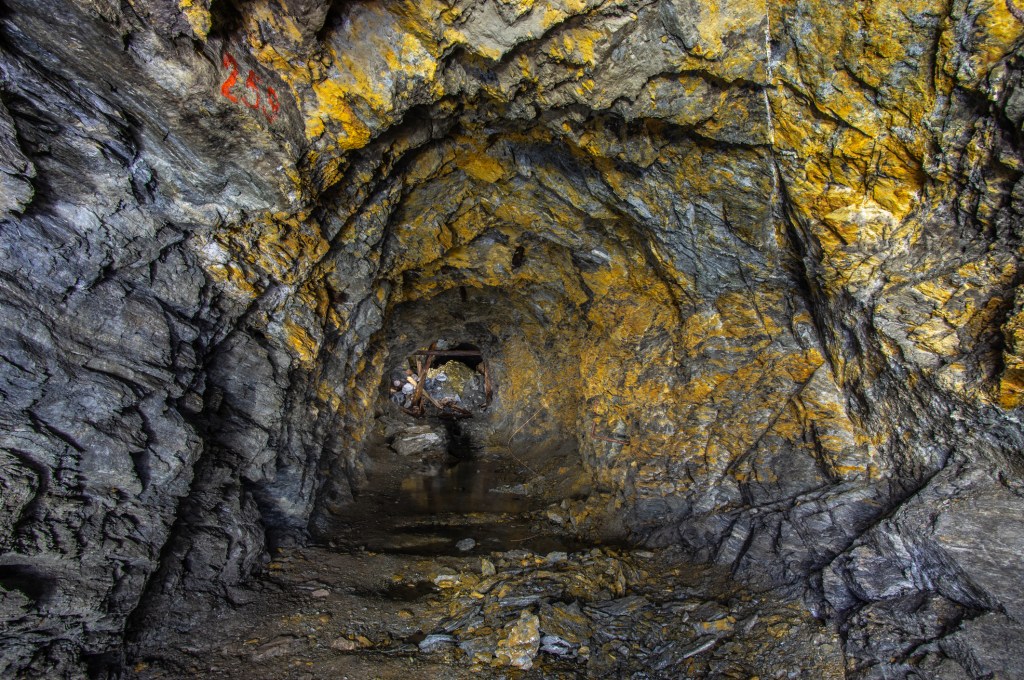
Sonny knows the dangers involved with cave exploration, but the excitement of the discovery overrides his usual caution. Slipping through the opening, he turns on his light, half scrambles, and half slides his way to the cave’s floor. Shining his light around the bowl-shaped space, he sees flashes of exposed gold everywhere, like someone took a brush and started flinging gold paint. The chamber, probably once a raging river, was cut into a U shape as the water channel around the curve wore the walls smooth.

Walking along the inner wall, Sonny reached up and started tracing a vein that varied in width from four inches to over a foot thick. Training his flashlight on the mesmerizing color, he follows the wall’s curvature, trying to imagine the value of what he was seeing.

He realizes that he has made a fatal mistake in a fraction of a second. Like slipping on black ice where one finds themselves on the ground before they even know they have slipped, Sonny’s next step is met with only air, catching him completely off balance. Sonny grasps the emptiness before him as he falls into an unknown void. The spinning beam of his flashlight flung from his hands in desperation is the last image he sees before total blackness.

Sonny did not know how far he fell, but it didn’t matter; landing on jagged rocks, he was broken in many places and understood he had found his final resting place.

Nov 30, 2020.

Black Hills Chronicle

From Rapid City, SD, David Tillis was searching for the opening of the Loues Creek mine in a remote area west of Crazy Horse when he discovered an old Lakota carved walking stick in an abandoned shack. The carved stick had a secret compartment containing a rare leather painting. Experts authenticated the artifacts dating to the mid-1800s, and a NY auction company hired to sell the lot has set a reserve of 1.2 million dollars.

An Opening

An Opening

There is a story from my childhood that I have never told, a fantastical tale that I know to be true, even though the passing years have undoubtedly obscured some details. I have kept the story close during my lifetime because of its unpleasant nature, but I am now prepared to account for the events.

My name is Toby Clark, and in 1968, I was an ordinary kid living in an ordinary town with an extraordinary problem. Having just turned ten, I was the only child of a middle-class family. My dad, Steve Clark, was a mechanic working for the town’s only car dealership. My mother, Mary, worked part-time in a bookstore near the town center.

The small town of Stark, aptly named, had nearly 5,000 inhabitants and was built on a flat midwestern plain resembling an island of homes and streets surrounded by an ocean of corn. No interesting features made up the town with even less of interest to do. People who lived there complained of a wind that never rested. Its unsettled nature, irritating to many, became hauntingly unbearable for me.

I was a frail child who had fallen ill with the flu right before my 10th birthday. After spending three days in bed burning with fever, fighting chills, and battling nausea, I woke on the fourth morning drenched in sweat with a feeling of lightness. A tremendous internal battle fought, the combatants weary, had left my body.

On the last night of my illness, blackness from both sides, like thick curtains closing on a final act, narrowed my vision of the incoherent dreamscapes beyond. I felt darkness around me and wondered if my defenses had nearly lost the battle.

Frailer and more diminished, I lay still watching the motion of the sheers where my mother had cracked open a window. Although too close to the source, a sick smell permeated the room. During this in-between groggy state, I heard the first strange voice. “You’re better; you’re better.” Not a question or a statement, more like a rote affirmation lacking emotion or conviction. The words whispered were faint but distinct, repeating in sync with the billowing of the translucent material. Exhausted and unable to think, I drifted off.

In the coming weeks, I found it difficult to remember when the wind was just a sound of nature. Now, every light breeze manifested into whispers that ramped up into angry shouting during storms. The words were often incoherent ramblings and, other times, chilling and commanding my attention. There were hundreds of voices, and their onslaught on my psyche was relentless. I tried everything to escape, but nothing drowned them out for long.

I remember when it started, watching the expressions of people around me and realizing in horror that I alone could hear them. I desperately wanted to tell someone, anyone. Each evening, my dad seemed unapproachable, looking exhausted and sitting hypnotized by the television. My mother, who rarely smiled, and had a habit of berating me for not being like other kids, was out of the question.

When possible, I stayed indoors even though I could still hear the voices sounding like a room full of incoherent conversations. When riding inside a car, the sound mimicked a radio tuning knob turned quickly through the AM band-only single words or partial words were distinguishable. The multiple tones and pitches are a disturbing reminder of the number of otherworldly conversations on the air currents.

There was chaos to my days, forcing me to seek solace wherever I could. Sometimes there were no words, just laughter or breathing at night, that never failed to raise hairs on my neck.

On days with gentle breezes, words were whispered, lending them a sinister secretive feel. Many dealt with people performing bad deeds, “Brad is bullying Christopher, Shelia is drunk, Marge is cheating on her husband.” Other times they spoke of people alone and scared in desolate places. “Elizabeth is lost in Baker Wood.” The latter gave me an uneasy feeling about the person’s welfare.

Typical for my age, I disavowed any unnecessary affiliation with my parents when my friends were present. Still, on days when I was alone in my room, I felt better if I could hear my mom rummaging about in the kitchen.

As spring turned to summer, the hot wind pushed slowly across concrete sidewalks and softened tar in the streets—distant lightning in the evening, the only hope of relief from the sticky air.

Much of the clutter and randomness of the voices fell away as summer progressed, leaving only the lonely voices weak and breathless like the slow-moving air. The whispered words often left me frightened and helpless. “It’s dark; I am cold; I want to go home.”

One of the voices I believed to be of a young girl had a hollow quality to it, and something else in the background I couldn’t make out. I heard her mainly in the evenings, and on this particular night, after closing the lid on the garbage container and hurrying toward the house, I heard her cry for help. It didn’t come from any particular direction; the voice came out of every dark and gloomy corner in the alley. Exasperated, I  muttered under my breath, “who are you?” And out of the darkness, her meek response of “Elizabeth Stemple” scared me badly. Panicked, I sprinted the remaining distance to the door, jerked it open, slammed it shut, and stood with my back pressed against it.

I  shuddered to think that conversation might have always been an option. Since the beginning, however discomforting, the voices had allowed me a level of detachment, like eavesdropping on invisible people. This new and unwelcome development was something else entirely.

Each year as the July 4th holiday approached, a profound sadness would seep into our home and disrupt routines, especially those concerning my mother. My dad awkwardly tried to fill in by fixing TV dinners or bringing home fast food. During this time, my mother rarely left her room, and if she did, she would wander through the house in her nightgown, clutching a worn leather binder. Conversations between my parents were hushed like the voices in church before service started.

I had never seen what was inside the binder, and it only ever appeared during this time of year. Things returned to normal after a few days, the sadness dissolving into more general unhappiness for my mother.

On Monday morning, July 8, I woke to a silent house, and on closer inspection, the sad time appeared to be ending, and routines, like going to work restored. A note held to the fridge by a magnet in my mother’s handwriting stated she would be home around 2:00 PM. Returning to my bedroom, I hesitated outside my parents’ open doorway and saw the leather binder lying on her nightstand.

Carefully carrying the binder into the kitchen, I set it on the counter. Opening its cover revealed a yellowed newspaper clipping inside a plastic sleeve. A picture between the headline and text showed two young girls in the same patterned dresses smiling out from the page—each girl looking like a replica of a young version of my mother.

Reading the headline,  “Identical Twin Elizabeth Stemple Vanishes During Fourth of July Celebrations,” my hands trembled, a coldness like the chills moved through my body as I grasped the inevitability confronting me.

At 2:00 PM, with a tear-streaked face, I stood exhausted and empty, a few feet inside the kitchen door. Clutching the binder in both hands, I heard my mother arrive and braced myself with the small amount of strength remaining inside me. Watching her expression as she opened the door, I saw a flicker of anger when seeing the binder. Her anger turned to compassion at the sight of the vulnerable child standing before her.

“Nobody took me – nobody hurt me,” I said in an unrecognizable voice, sounding hollow and distant. Her eyes filled with tears, and an unspoken awareness passed between us.

“It was my fault –  I made a mistake,” the words flowed through me.

Her eyes searched my face with an intensity I had never experienced, like a veil had lifted, allowing her to finally see the little boy, her son, for the first time.

More words came through.

“I couldn’t get out; I tried, the water came fast, trapping me, I tried to climb, I never meant to leave you, I tried.” The words trailed off into silence.

Rushing forward, she wrapped her arms around me and could only manage “I am so sorry,” over and over between uncontrolled sobbing.

That evening near sunset, sitting outside on the front steps, I watched a copper spinner on the lawn, its two wheels moving in opposite directions in the steady breeze. It was a quiet evening, with the only sound,  a slight metallic ticking from one of the wheels being slightly out of balance.

Superior

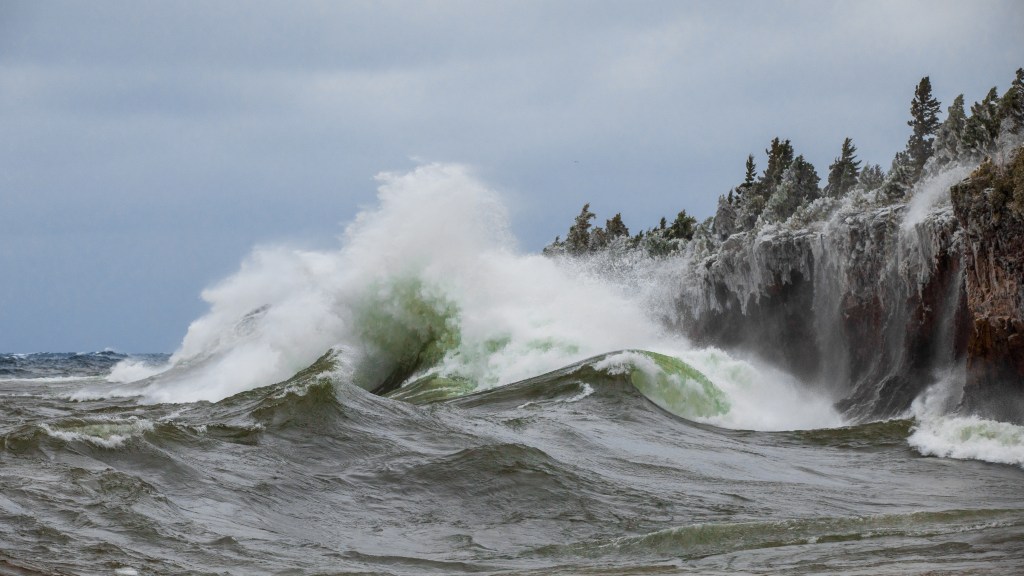
I have seen the fury of this inland sea; her rollers piled high in November gales

I have heard her thunderous chorus along the North Shore, craggy and hard against the assault

I have felt her frigid spray on top ten-story cliffs jettisoned skyward by mighty collisions

I have listened to sobering stories of shipwrecks and ten thousand souls down in her depths

I have marveled at her serenity in calmer times, always respectful of an untamed spirit

I have breathed the scented air of pine and birch forests hugging close to her rugged shore

I have watched the magical lights in the north dancing along her horizon

I have looked into the depth of the stars and galaxies hinting at the universe above her body

I have stood on her shore staring into the past, a primitive vastness unchangeable by man

And I find an inner peace whenever in her presence

Desolation

There is probably no other town within 500 miles as unremarkable as Calvington, Minnesota. Todd Birch could attest to that; he had lived here his entire life, all 13 years. Farmland was his view in any direction, and the flatness made the sky a dominant feature—all that blue making the town even more insignificant if that was even possible.

A two-lane highway split the town in half, running for a five-block stretch comprising Calvingtons Main Street before fading into a mirage in the distance. There are only three buildings on Main Street that might one time have qualified as businesses; today, they are empty placeholders from another time. Todd’s home, standing at the end of a two-block street, butts up to farmland. The field, covered in large leafy plants, march in neat rows up a slight incline to a small ridge in the distance.

When Todd steps out the front door each day, he immediately feels depressed about his monotonous surroundings. At some point, after standing on the home stoop for several minutes, he invariably makes his way the two blocks to the highway in hopes of discovering something – anything, of interest. Each time though, desolation greets him, and the cycle of feeling sorry for himself begins anew. What possible trick of fate has stranded him in such a place?

 A few other shabby kids significantly younger than Todd face the same danger as him, living in Calvington, and dying of boredom. All the kids of school age ride on a dilapidated bus that is hard to imagine ever new. The bus brings the kids 15 miles south to a larger town with middle and high schools. Todd looks forward to the start of school each year and dreads the endless days of summer.

Standing on the edge of the highway, he sees the heat rising off the asphalt in the distance. Gently he cups his right hand to protect the Chesterfield he took from his mother’s open pack. Putting it between his lips, he flips open his Zippo lighter and lights the end. The lighter, one of his prized possessions, has a solid feel; he loves the smell of the lighter fluid and the satisfying clicking noise it makes when opening and closing.

He takes a long drag and inhales deeply before exhaling through his nose. He always gets a bit of a head rush whenever he has not smoked in a few days. He has limited access to cigarettes, and the ones he steals need to be from packs with enough remaining not to draw attention.

Usually, he would find an out-of-the-way place to shield himself from view when smoking, but the emptiness of the town today is so complete, he doesn’t see the point. Walking across the two lanes, he peers through a filthy window into a hall with a for rent sign taped to the door. He can not imagine anyone wanting to hold an event in this town, and as far as he can remember, no one had.

Sitting on the window ledge, he smokes the cigarette down to the filter before flicking onto the sand and dirt of the parking area. He doesn’t own a watch but figures it can’t be much past 10:00 AM, and he has no clue how to fill the rest of the day.

Todd, hearing an eighteen-wheeler in the distance upshifting gears, thinks it an odd sound since the 15-mile approach into Calvington is a wide-open highway, and trucks’ only gear change is when approaching the town to downshift before rumbling through at 20 or so mph over the speed limit.

Todd, standing in the middle of the highway, looks south where he heard the sound; not detecting any movement, he continues across, making his way toward home. He senses or maybe feels a low rumble, and reaching the end of the first block, turns back toward the highway just in time to see a massive truck rolling slowly through the intersection. All in shiny black, the monstrosity has cowlings so low he could not even be sure it was moving on wheels. Shortly after passing from sight, the rumbling subsided slightly, and he did not hear any of the usual upshifting that would be needed to regain highway speed.

There was no way the vehicle could have exited the town that quickly; the highway to the north was flat, and anything moving you could see for miles. Todd jogged back to Main Street and didn’t see anything moving in either direction. Walking the five blocks to the north side of town, he started to question whether he had seen the vehicle at all.

Reaching the end of town, he turns right and makes his way toward home; he takes the back street bordering the farmland. As he approaches the end of the two-block stretch, he notices something different about the field; coming closer, he sees what did not look right. Two large tracks with deep impressions have crushed the leafy plants across the area and up an incline before disappearing on the other side of the ridge. The colossal vehicle has not left town; for some reason, it was out on the land.

“Wow,” Todd said under his breath, “this is weird.” The houses behind him had their shades drawn down so that no one may have seen the truck. Todd looking at the crushed vegetation, figured the landowner would be pissed when he saw it. His impulse was to follow the tracks but thought it might be wiser under cover of darkness. He had no idea who these people might be.

Back at home, Todd looked for anything besides his chores to pass the time until nightfall. What was incredibly annoying was the length of the summer days, which were like adding insult to injury.

Finally, sunset approached, and the day’s light faded; Todd watched from his second-story bedroom window as the fields became covered in darkness. He grabbed the six-cell flashlight from his desk and turned it on and off several times, ensuring the batteries were still good. Feeling the Zippo lighter in his pocket, he hoped he could swipe a couple more smokes on his way out for the adventure.

Todd had become accustomed to going alone, but he would have loved to have a partner tonight. Cupping his hand over the flashlight lens, he kept the light low, illuminating the ground where the vehicle entered the field. It reminded him of the Sherlock Holmes story where Sherlock and Watson used a dark lantern to get into position before slipping a screen over the glass to darken the light as they waited for their prey.

Todd pressed into the field and stayed within one of the depressions created by the vehicle. It was easy-going walking over the crushed plants. Flicking the flashlight on for a second or two at intervals allowed him to check his progress. As he reached the top of the slight ridge, he could see lights near the bottom of the depression in the land. The area during heavy snow melts or torrential rains formed a small lake. Five or more shielded lights shone on the ground, around the mysterious vehicle.

Unsure of what to expect at the site, Todd slowed his pace and moved as quietly as possible. He decided to cover the remaining distance within the cover of the crop. Hunching down low and creeping closer, the vehicle reminded him of an enormous transformer toy mainly in the shadows. When passing the intersection earlier in town, the unusual domed rear stood erect, with its narrow end pointing toward the night sky. The body had a tubular rocket shape and was attached to a rail that looked like a section from a modern roller coaster. Support legs extending out from the truck’s bed looked like a giant metal spider.

There was wispy smoke, the consistency of steam vapor coming from the side of the vertical object that quickly dissipated into the night air.

Todd still did not see any sign of people around the site, nor any structure where they might be. A heavy wind rushed across the field, causing a creaking noise from the vicinity of the rocket-shaped object.

Todd lowering himself into a crawling position moved cautiously toward the clearing; he could smell the earth where the massive wheels had crushed the plants into the soil. Poking his head into the clearing, he watched and listened. It seemed as if whoever drove the truck into position had abandoned the site.

It occurred to him that what he saw in front of him was by far the most exciting thing he had ever witnessed since living in the mundane town of  Calvington, and with that thought came a premonition about how tonight could change his life.

Summoning his courage, Todd moved into a squatting position and, while keeping his head low, moved across the clearing, covering the distance to the truck and ducking into the shadows between pools of light. Looking up at the standing object, he estimated it to be at least twenty feet in height to the top of its dome. Several rows of LEDs intermittently blinked on panels shielded behind dark tinted glass doors on the truck’s bed.

Todd could appreciate the site they had chosen as he crouched in the shadows near the rear of the vehicle. Nothing could be seen here from either side of the field unless you stood near the ridgeline.

Moving toward the standing object, Todd ran his hand along its shiny black metal surface as he walked its circumference. A swift sliding noise from above froze him in his tracks. Another lower sound of whirring motors pushed out an object from the opening that unfolded in several elaborate steps to become a ladder along its side. Todd pressing hard against the bottom of the vertical shape feared the commotion would alert someone to his presence.

The bottom of the ladder, only a few feet from where Todd crouched in the shadows, seemed to wait patiently for a passenger to climb its rungs. Todd stayed put, listening to the intermittent wind, crickets, and a creaking noise from the apparatus supporting the vertical object. He desperately wanted to have a peek inside the capsule but was afraid of being exposed.

Grabbing the bottom rung from the back of the ladder and using it for support, he swung himself around to the front. Taking a last look around the site, he scrambled up the ladder and stuck his head into the opening. He heard the muted chiming of electronic circuitry that almost sounded musical. There was a cozy, inviting feel about the interior, and the circulating air was cool and dry. The space consisted of a circular recessed area with a two-foot-wide walkway around its perimeter. Lights embedded in the floor at the edge of the circular area precisely lined up with lights on a mirror image of the space suspended overhead.

The walkway provided operator access to panels running in a narrow band encircling the capsule about four feet above the floor. The controls, like on the bed of the vehicle, were behind tinted glass.

Hearing a sound from behind, Todd quickly scrambled the rest of the way into the opening and laid flat on the interior walkway. With his face pressed to the floor, he listens as whirring motors reseat the ladder underneath the walkway’s surface. A fast sliding sound follows with the closing of the door that seals him into the capsule.

Standing, he finds the capsule only provides a few extra inches of clearance from its sides as the walls slant inward toward the dome. Panicked, he looks up to see a small red lever near the sliding door mechanism. Pushing the lever up, he expects the door to open, but instead, a wall of screens encircling the interior comes to life. Todd, violently trembling, stares at the screens and realizes they are of the small pools of light illuminating the ground around the site.

He feels a vibration on the floor, and everything he touches, like something in the bowels, is lightly shaking the structure. There are too many complicated controls even to start to figure out how he might escape. He tries to think of what he will say when discovered inside.

Feeling safer down low, Todd sits on the walkway and swings his legs over the edge of the recessed area; sliding forward, he lowers himself onto the cushioned surface. Once clearing the threshold, the embedded lights in the floor and the ones suspended start increasing in intensity until the shafts of light look like bars surrounding the circle. Staring at the extreme brightness, he fails to notice the suspended object descending toward the floor. When finally realizing what is happening, the gap is too small to escape. When the moving cap meets the floor, it emits several mechanical locking sounds and a sharp hiss of air like a slowly opening soda bottle.

Todd has a 360-degree view of the capsule screens and control panels. The enclosure’s cover is entirely translucent except for a small metal band housing the mechanics that coupled it to the recessed circle. Looking up, Todd can see a  sequence of numbers somehow suspended in the air like a hologram. The numbers are in four sets of two digits separated by spaces and appear to be counting down. The numbers displayed are  00 00 59 45, and the last set changes every second.

Todd resigns himself to the fact of not getting out until someone discovers his breech. Having never been in trouble before, he has no idea of what to expect. The panels outside the circular enclosure are alive with activity, and the capsule is incrementally moving and adjusting its angle like trying to find the perfect trajectory. He sees no controls within his space and imagines a remote operation or a scarier thought about an automatic pilot sequence.

Helplessly and with no other options, Todd watches the numbers continue counting down above him. His memory suddenly flooded with images from his past, like when the town put up an enormous Christmas tree on a vacant lot, and everyone participated in decorating. He remembers how the night sky lights up with enough stars to rival the best fireworks show and how the land transforms after the first snowfall. He remembers small patches of woods coming alive with fireflies on summer nights and lying in bed, watching lightning in the distance and counting the seconds until he hears the thunder. And he remembers the winds, heavy and determined in the fall and winter, and light and gentle in the spring.

And as the clock reaches 60 seconds, Todd understands no one is coming to find him inside the capsule. The low rumbling vibration he felt upon entry has turned to a full-fledged trembling of the structure, and whatever ties are holding it in place are about to be shredded from the power of its launch. Lying still on his back, he sees oxygen flow into the enclosed space from several small vents. When the counter reaches zero, his body is compressed into the cushion with a force that embeds him into the material like a giant puzzle piece, and he cannot move. He watches the monitors and sees his town move away from the rocket until it disappears into the larger landscape of the earth. The view is breathtaking, and the possible adventure in front of him is full of excitements and unknowns, but all that pales in comparison with a desire to resume his old boring life in the extraordinary hometown of Calvington.

Joseph Benedict Reads The Last Chapter 46 of “Frozen Harvest” – The Cold Case Detective Novel

Last Chapter 46 synopsis: “Disappointed that the case of Mary’s disappearance remains unresolved, Joel heads back to the cities after saying goodbye to Sam at the museum and resolving to continue the investigation. On the drive back with time to think, Joel remembers a piece of information found during research that seemed insignificant at the time but could hold the key to the case’s resolution.” – From Frozen Harvest Book written by Joseph Benedict.

Video URL: https://www.youtube.com/watch?v=0xWgS18g0GQ&list=PLGA2_kFWaNHVamhplrEOaNSFYyih8glsg

In this video series, The Author, Joseph Benedict, reads from his book Frozen Harvest, The Detective Cold Case Novel, and invites you to read along with him, or hang back and enjoy. In this Video Joseph reads The Last Chapter 46 of the book, which are pages 189 through 193. The Author will release a video weekly and hopes that you’ll join him as we follow Detective “Joel Vick” on his journey of solving the mysterious Cold Case of Mary Benton.

Overview of “Frozen Harvest”: Mary Benton, traveling alone by train, arrived in the small town of Seven Lakes, Minnesota, on December 5, 1925. In the early evening of December 22, Mary left her room at The Seven Lakes Grand Hotel, venturing out into the middle of a severe snowstorm, never to return. Authorities at the time ruled her disappearance, an accidental death due to exposure even though they never recovered her body. A mysterious letter arriving at the office of Minneapolis detective Joel Vick, nearly ninety years after her disappearance, suggested there may have been something else at play on that fateful night.

Genre: FICTION, Mystery and Detective. Current edition: 200 pages Paperback.

Book Detailed Description: Joel Vick, a Minneapolis detective, down on his luck, receives an opportunity in the form of a mysterious letter delivered to his office. The letter alludes to a 90-year-old missing person case that took place in the small northern Minnesota town of Seven Lakes. Joel, as a child, had spent numerous summers in Seven Lakes vacationing with his family. With a downturn in requests for his services locally, and his natural curiosity aroused, Vick drives up to have a look at the town he hadn’t visited in over 40 years. Initially frustrated that he had wasted his time after visiting the person who wrote the letter, Vick discovers something unusual that changes his mind about leaving. Vick, digging further into the case, determines that the investigation performed at the time of her disappearance to be entirely inadequate. Using his investigative skills, Vick stitches together a story of a beautiful young woman who is looking for a new start, but unable to escape her past. The story set against the backdrop of severe winter snowstorms, extreme cold, and a robust ice harvesting industry that flourished in the decades before refrigeration rendered it obsolete.

About the Author: Joseph Benedict, born and raised in Minneapolis, Minnesota, spent eight years in the US. Air Force before joining the corporate world. For the past nine years, Benedict has been a writer who tells his company narratives through articles, features, and press releases. Benedict loves the creative process of telling a good story and maintains a blog where he publishes his works of fiction and daily human struggles. Benedict currently makes his home in Camden, SC.

Order your copy of the book by visiting Select Bookstores, all Online Booksellers, BookBabby Bookshop; Amazon; and Barnes & Noble. Follow Joseph Benedict Blog by visiting:  https://josephbenedictblog.com/

Related Hashtags: #JosephBenedictReads #FrozenHarvestBook #JoelVickDetective #JosephBenedict #JosephBenedictAuthor #DetectiveNovel #Fiction

Joseph Benedict Reads Chapter 45 of “Frozen Harvest” – The Cold Case Detective Novel

Chapter 45 synopsis: “Joel waits impatiently at the hotel for any news from the State Police divers exploring the lake bottom in the area his investigation indicated. The night before, he had rescued a young boy wandering onto the lake ice during near white-out conditions, ironically in search of the same thing as Joel.” – From Frozen Harvest Book written by Joseph Benedict.

Video URL: https://www.youtube.com/watch?v=aqPGgR1q35E&list=PLGA2_kFWaNHVamhplrEOaNSFYyih8glsg

In this video series, The Author, Joseph Benedict, reads from his book Frozen Harvest, The Detective Cold Case Novel, and invites you to read along with him, or hang back and enjoy. In this Video Joseph reads Chapter 45 of the book, which are pages 183 through 188. The Author will release a video weekly and hopes that you’ll join him as we follow Detective “Joel Vick” on his journey of solving the mysterious Cold Case of Mary Benton.

Overview of “Frozen Harvest”: Mary Benton, traveling alone by train, arrived in the small town of Seven Lakes, Minnesota, on December 5, 1925. In the early evening of December 22, Mary left her room at The Seven Lakes Grand Hotel, venturing out into the middle of a severe snowstorm, never to return. Authorities at the time ruled her disappearance, an accidental death due to exposure even though they never recovered her body. A mysterious letter arriving at the office of Minneapolis detective Joel Vick, nearly ninety years after her disappearance, suggested there may have been something else at play on that fateful night.

Genre: FICTION, Mystery and Detective. Current edition: 200 pages Paperback.

Book Detailed Description: Joel Vick, a Minneapolis detective, down on his luck, receives an opportunity in the form of a mysterious letter delivered to his office. The letter alludes to a 90-year-old missing person case that took place in the small northern Minnesota town of Seven Lakes. Joel, as a child, had spent numerous summers in Seven Lakes vacationing with his family. With a downturn in requests for his services locally, and his natural curiosity aroused, Vick drives up to have a look at the town he hadn’t visited in over 40 years. Initially frustrated that he had wasted his time after visiting the person who wrote the letter, Vick discovers something unusual that changes his mind about leaving. Vick, digging further into the case, determines that the investigation performed at the time of her disappearance to be entirely inadequate. Using his investigative skills, Vick stitches together a story of a beautiful young woman who is looking for a new start, but unable to escape her past. The story set against the backdrop of severe winter snowstorms, extreme cold, and a robust ice harvesting industry that flourished in the decades before refrigeration rendered it obsolete.

About the Author: Joseph Benedict, born and raised in Minneapolis, Minnesota, spent eight years in the US. Air Force before joining the corporate world. For the past nine years, Benedict has been a writer who tells his company narratives through articles, features, and press releases. Benedict loves the creative process of telling a good story and maintains a blog where he publishes his works of fiction and daily human struggles. Benedict currently makes his home in Camden, SC.

Order your copy of the book by visiting Select Bookstores, all Online Booksellers, BookBabby Bookshop; Amazon; and Barnes & Noble. Follow Joseph Benedict Blog by visiting:  https://josephbenedictblog.com/

Related Hashtags: #JosephBenedictReads #FrozenHarvestBook #JoelVickDetective #JosephBenedict #JosephBenedictAuthor #DetectiveNovel #Fiction

Joseph Benedict Reads Chapters 43-44 of “Frozen Harvest” – The Cold Case Detective Novel

Chapter 43 synopsis: “After nearly wrecking his car, trying to avoid the flash of orange in his headlights, Joel finds footprints leading down an embankment and out onto the ice. With no other options available, he follows the prints to hopefully rescue whoever was foolish enough to go out on the ice in the severe storm.”

Chapter 44 synopsis: “Joel gets a call at his hotel the morning after the dramatic incident on the lake from Detective Sims. Joel, not wanting to disturb Sam, who is still sleeping, takes the call in the lobby and receives information on the person who ransacked his room the night before.” – From Frozen Harvest Book written by Joseph Benedict.

Video URL: https://www.youtube.com/watch?v=m46OWR0YIVs&list=PLGA2_kFWaNHVamhplrEOaNSFYyih8glsg

In this video series, The Author, Joseph Benedict, reads from his book Frozen Harvest, The Detective Cold Case Novel, and invites you to read along with him, or hang back and enjoy. In this Video Joseph reads Chapters 43 and 44 of the book, which are pages 175 through 182. The Author will release a video weekly and hopes that you’ll join him as we follow Detective “Joel Vick” on his journey of solving the mysterious Cold Case of Mary Benton.

Overview of “Frozen Harvest”: Mary Benton, traveling alone by train, arrived in the small town of Seven Lakes, Minnesota, on December 5, 1925. In the early evening of December 22, Mary left her room at The Seven Lakes Grand Hotel, venturing out into the middle of a severe snowstorm, never to return. Authorities at the time ruled her disappearance, an accidental death due to exposure even though they never recovered her body. A mysterious letter arriving at the office of Minneapolis detective Joel Vick, nearly ninety years after her disappearance, suggested there may have been something else at play on that fateful night.

Genre: FICTION, Mystery and Detective. Current edition: 200 pages Paperback.

Book Detailed Description: Joel Vick, a Minneapolis detective, down on his luck, receives an opportunity in the form of a mysterious letter delivered to his office. The letter alludes to a 90-year-old missing person case that took place in the small northern Minnesota town of Seven Lakes. Joel, as a child, had spent numerous summers in Seven Lakes vacationing with his family. With a downturn in requests for his services locally, and his natural curiosity aroused, Vick drives up to have a look at the town he hadn’t visited in over 40 years. Initially frustrated that he had wasted his time after visiting the person who wrote the letter, Vick discovers something unusual that changes his mind about leaving. Vick, digging further into the case, determines that the investigation performed at the time of her disappearance to be entirely inadequate. Using his investigative skills, Vick stitches together a story of a beautiful young woman who is looking for a new start, but unable to escape her past. The story set against the backdrop of severe winter snowstorms, extreme cold, and a robust ice harvesting industry that flourished in the decades before refrigeration rendered it obsolete.

About the Author: Joseph Benedict, born and raised in Minneapolis, Minnesota, spent eight years in the US. Air Force before joining the corporate world. For the past nine years, Benedict has been a writer who tells his company narratives through articles, features, and press releases. Benedict loves the creative process of telling a good story and maintains a blog where he publishes his works of fiction and daily human struggles. Benedict currently makes his home in Camden, SC.

Order your copy of the book by visiting Select Bookstores, all Online Booksellers, BookBabby Bookshop; Amazon; and Barnes & Noble. Follow Joseph Benedict Blog by visiting:  https://josephbenedictblog.com/

Related Hashtags: #JosephBenedictReads #FrozenHarvestBook #JoelVickDetective #JosephBenedict #JosephBenedictAuthor #DetectiveNovel #Fiction

Joseph Benedict Reads Chapters 41-42 of “Frozen Harvest” – The Cold Case Detective Novel

Chapter 41 synopsis: “TJ venturing out onto the ice in the storm’s dangerous conditions, soon finds himself facing one of his worst nightmares.”

Chapter 42 synopsis: “Sam no longer can logically reason with Joel’s lack of communication, and with his whereabouts unknown, she goes in person to Seven Lakes Police Department to file a report.” – From Frozen Harvest Book written by Joseph Benedict.

Video URL: https://www.youtube.com/watch?v=UcmcuDQl5WA&list=PLGA2_kFWaNHVamhplrEOaNSFYyih8glsg

In this video series, The Author, Joseph Benedict, reads from his book Frozen Harvest, The Detective Cold Case Novel, and invites you to read along with him, or hang back and enjoy. In this Video Joseph reads Chapters 41 and 42 of the book, which are pages 170 through 174. The Author will release a video weekly and hopes that you’ll join him as we follow Detective “Joel Vick” on his journey of solving the mysterious Cold Case of Mary Benton.

Overview of “Frozen Harvest”: Mary Benton, traveling alone by train, arrived in the small town of Seven Lakes, Minnesota, on December 5, 1925. In the early evening of December 22, Mary left her room at The Seven Lakes Grand Hotel, venturing out into the middle of a severe snowstorm, never to return. Authorities at the time ruled her disappearance, an accidental death due to exposure even though they never recovered her body. A mysterious letter arriving at the office of Minneapolis detective Joel Vick, nearly ninety years after her disappearance, suggested there may have been something else at play on that fateful night.

Genre: FICTION, Mystery and Detective. Current edition: 200 pages Paperback.

Book Detailed Description: Joel Vick, a Minneapolis detective, down on his luck, receives an opportunity in the form of a mysterious letter delivered to his office. The letter alludes to a 90-year-old missing person case that took place in the small northern Minnesota town of Seven Lakes. Joel, as a child, had spent numerous summers in Seven Lakes vacationing with his family. With a downturn in requests for his services locally, and his natural curiosity aroused, Vick drives up to have a look at the town he hadn’t visited in over 40 years. Initially frustrated that he had wasted his time after visiting the person who wrote the letter, Vick discovers something unusual that changes his mind about leaving. Vick, digging further into the case, determines that the investigation performed at the time of her disappearance to be entirely inadequate. Using his investigative skills, Vick stitches together a story of a beautiful young woman who is looking for a new start, but unable to escape her past. The story set against the backdrop of severe winter snowstorms, extreme cold, and a robust ice harvesting industry that flourished in the decades before refrigeration rendered it obsolete.

About the Author: Joseph Benedict, born and raised in Minneapolis, Minnesota, spent eight years in the US. Air Force before joining the corporate world. For the past nine years, Benedict has been a writer who tells his company narratives through articles, features, and press releases. Benedict loves the creative process of telling a good story and maintains a blog where he publishes his works of fiction and daily human struggles. Benedict currently makes his home in Camden, SC.

Order your copy of the book by visiting Select Bookstores, all Online Booksellers, BookBabby Bookshop; Amazon; and Barnes & Noble. Follow Joseph Benedict Blog by visiting:  https://josephbenedictblog.com/

Related Hashtags: #JosephBenedictReads #FrozenHarvestBook #JoelVickDetective #JosephBenedict #JosephBenedictAuthor #DetectiveNovel #Fiction