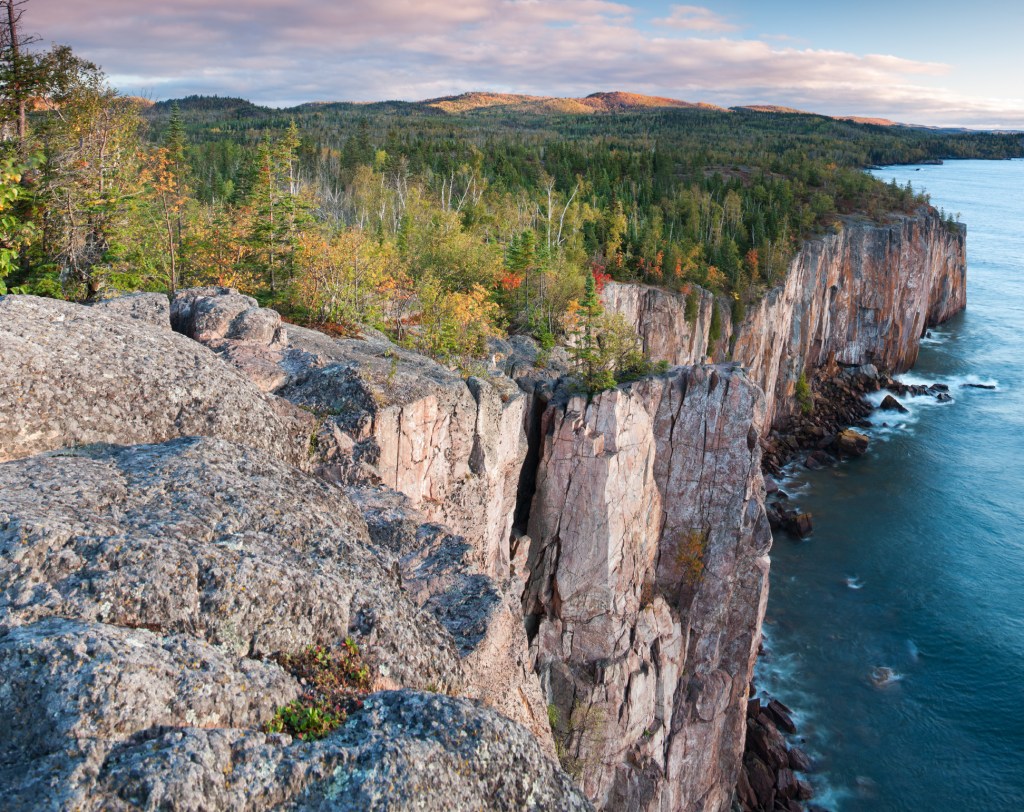
Lichen and moss of countless shades of green cling for life on misshaped boulders littering the forest floor. Dampness, the smell of earth, and decomposition fill my nostrils. I sense the open vastness of blue beyond the tree line but had yet to glimpse its true grandeur. Walking carefully now and hearing a low rumble of waves crashing far below, I expect a severe drop-off where the trees end. Closer now, I see the water’s surface stretching to the horizon with no land in sight.
As a child, I can remember the Lake’s mood changing throughout the day, sometimes wearing a shimmering silver coat, sometimes slate gray or a dark blue-green when a steady wind blew breakers against its rugged shores. Today’s surface comprises the most pleasing shade of blue, and the massive body of water is seemingly content within its confines.
Clearing the last of the trees confirmed my suspicion as the land abruptly ended, and sheer-walled cliffs dropped precariously a 100 feet or more to Superiors surface. The shoreline’s spectacular view to the North and South only revealing a tiny portion of the Great Lake’s magnificence.
Peering over the edge, I could see boulders deceptive in both size and depth scattered across its floor just beyond where the cliffs started their ascent —the clarity of the water rivaling the purest of fresh-water springs of Northern Florida.
The Lake is always conveying a sense of uncontrollable power whenever I get into proximity—the rocky shoreline and cliffs standing guard battle against gigantic waves during November gales.
The North Shore of Lake Superior from Duluth to Grand Portage is a window into an earlier, more primitive time, and Superior remains too massive and wild ever to be tamed by man.
I am sitting still on my perch at the top of the cliff, watching and listening to the most glorious of the Great Lakes. I am as always taken aback by its immense beauty, respectful of its power, and grateful for its ability to connect me to its ancient past.
 Joseph Benedict Blog