My First Car

There are some memorable milestones in life that, when reflected on, present themselves in vivid, emotional detail. For me, one of those milestones was my first car. I remember the moment I took possession of her, the smell of the interior, the bright fall day, sitting in the driver’s seat holding the wheel, and imagining all of the places I would go.

The car, a VW Beetle, was not much to look at, a beige brownish color, its paint weathered to a point where it would never shine again. The dashboard’s round speedometer and other controls looked to me as instruments of a new freedom. The year was 1974, and I don’t believe I ever knew the exact age of the Beetle, but suffice it to say, she had a couple of decades of use on her.

I paid 200.00 dollars for the car and remembered thinking it was a bargain. Cars that spent any time on the roads in Minnesota had a propensity for rust, and the Beetle was no exception. Salt was liberally spread on roads during the winter to combat ice and snow. The rust on the Beetle was especially prevalent around the wheel wells, and the panels closest to the roads surface. The most noticeable issue was a softball size hole in the driver side floorboards that went clean through to the street. My first thought upon seeing the hole was to dismiss it as a cosmetic problem that did not affect the operation of the car.

It was hard to find anything negative about the car to compete with things like a four-speed stick shift with a shiny plastic ball, the shifting pattern debossed into its top. I had not driven a car with a manual transmission before, but I did own a dirt bike, so I was familiar with the concept of a clutch. It took a few excursions to get the hang of shifting, and the only precarious moments remaining involved stopping on a hill and trying to get going without hitting the car behind me.

The Beetle did not have much power, but cornered well and was fun to drive. One quality of a car people looked for in that region of the country was how well the heater worked. In my excitement of ownership, this important step somehow slipped my mind, and I discovered as fall turned to winter, that the heating system was nearly non-existent. The same pesky rust that was eating the car from the ground up had destroyed the conduits in which warm air was supposed to flow from the engine. Adjusting to this reality, I dressed like a polar explorer whenever driving the car.

There was a funny moment while driving in a fall rainstorm and going through large puddles of water. The hole in the driver’s side floorboards, which I had believed to be purely cosmetic, suddenly turned into a geyser of water between my legs. The solution based on available materials at my parent’s home consisted of cutting a piece of plywood to a reasonable semblance of the floor. The wood did not exactly create a seal, and during a subsequent winter snowstorm, blowing snow found its way through the hole creating a miniature four-inch snowdrift inside the car.

The first thing to go wrong mechanically with the car was the starter, but since it was a manual transmission, I was able to start it with a little forward momentum. It was a small feat of coordination involving pushing the car from the driver’s side to gain momentum, jumping into the driver’s seat, shoving the stick into first gear, and popping the clutch to get the engine to turn over. Soon I was looking for every incline in the city for parking to have an assist in restarting the car. That same winter, the brake lines developed a leak causing the master cylinder to lose pressure for applying the brakes. With a little practice, I mastered the art of braking through downshifting, and when I needed a full stop, I employed the emergency brake.

Life seldom follows the road-maps our minds conjure up, and the places I imagined I would travel on that first glorious day never came to fruition. My first car had left me stranded on lonely rural stretches; in winter, it was like driving a freezer on wheels, and the car challenged the very meaning of work-around. Looking back on that day where I sat in the driver’s seat, my hands on the wheel, I realize the value of the experience, and would never trade that away.

Metal Detecting Through Time

Did you ever see a person doing something when you were a kid that you thought was dorky, and then later in life, you found yourself doing the same thing?

 I started metal detecting about four years ago when my girlfriend at the time who is now my wife and who encourages me to embrace my nerdiness, bought a metal detector for my birthday. I remember the first time I detected was on Folly Beach SC. After arriving at the beach, and while standing at the rear of my car, I prepared for the adventure by attaching a camouflage pouch with a belt around my waist. The pouch held my digging shovel, magnifying glass, and a few other miscellaneous items used in the pursuit of treasure. The rest of my outfit consisted of hiking boots, long woolen socks with red stripes, cargo shorts and, a floppy hat.

When I started to pull the new detector from its carrying case, my girlfriend took a quick look at my outfit and suggested I might want to keep it inside the case on the way to the beach. Once on the beach, she suggested I could store the case near where I would be detecting and that she would watch me from a distance.  Now I am not a scientist, but I was getting the feeling she was trying to disassociate herself from my new hobby.

For the first hour or so, I was doing a lot of digging and sifting through the sand after hearing each signal but had little luck in actually finding anything. Finally, after another 30 minutes, I pulled a real bit of metal out of the sand. There was another detectorist in the general area who had been keeping his distance, but now that I had found something, and was apparently looking at it with a confused expression, he came over to have a look.  

You can always tell an experienced detectorist because they are confident when identifying finds. “That’s a such and such caliber bullet from World War ll,” he informed me. Then putting his hands on his hips, gazed toward the water as if imagining another time and place and said,  “yep, they used these beaches for target practice during the war.” Looking back at the object, and then at me, I think he was trying to determine if it was dumb luck on my part, and after making up his mind, and before sauntering off, said, “That’s a good find.”

It is hard to explain the attraction to a hobby where I mostly find scraps of metal or old soda cans, and rarely anything of value. I think it is a bit like Pavlov’s dog; each time I hear a signal in the headset, I  realize there is the possibility of real treasure lying below the surface. I know from experience that the chances of it being of no value is high, but I have to look to be sure. I also understand from watching YouTube videos of other detectorists, that there is a bit of science to getting your detectors settings right, so you don’t waste time digging up junk. I have not quite mastered that part yet, and still find myself digging every signal.

There is an immensely funny British series produced about metal detecting called “detectorist.” The show, which features superb cinematography and thoughtful writing, combines the main characters’ drive and passion for discovering a bit of history along with a humorous cast of misfits who aptly represent the quirkiness of the hobby. There is a poignant conversation at the end of the last episode where Lance, one of the main characters sums up why he continues to detect. “Metal detecting is the closest you will get to time travel. We unearth the scattered memories, mine the stories, fill in the personality. Detectorists, we’re time travelers.” That’s certainly good enough for me, even though a lot of my stories are about common litterbugs.

A Halloween Celebration

Jerald Stubbs was a superstitious ten-year-old who used routine to battle perceived evil. It was not the Devil kind of evil the preacher at his church railed against on Sunday mornings; this was more about keeping his distance from ghosts and spirits, who he believed inhabited his small world. Even though he had these fears, he still enjoyed Halloween and was glad it had finally arrived. Kids who are dressing up as ghosts and ghouls, to collect free candy he understood. It was the times he found himself alone in unfamiliar places or fading light, where he became fearful of the things he could not see but believed to be there.

It was 5:15 PM when Jerald stepped off the school bus onto the dirt road that led to his house. It was nearly a mile walk from the main highway to his home. Most days he did not mind the walk, However, as the season changed and days got shorter, the evening shadows grew a bit larger each day. Today the sky was a cacophony of color with the sun hidden behind layers of clouds. There was a crispness in the air that felt like frost was likely by morning. Several farmhouses dotted the landscape along the way, and one abandoned farm where Jerald made sure he walked on the far side of the road while at the same time quickening his pace.

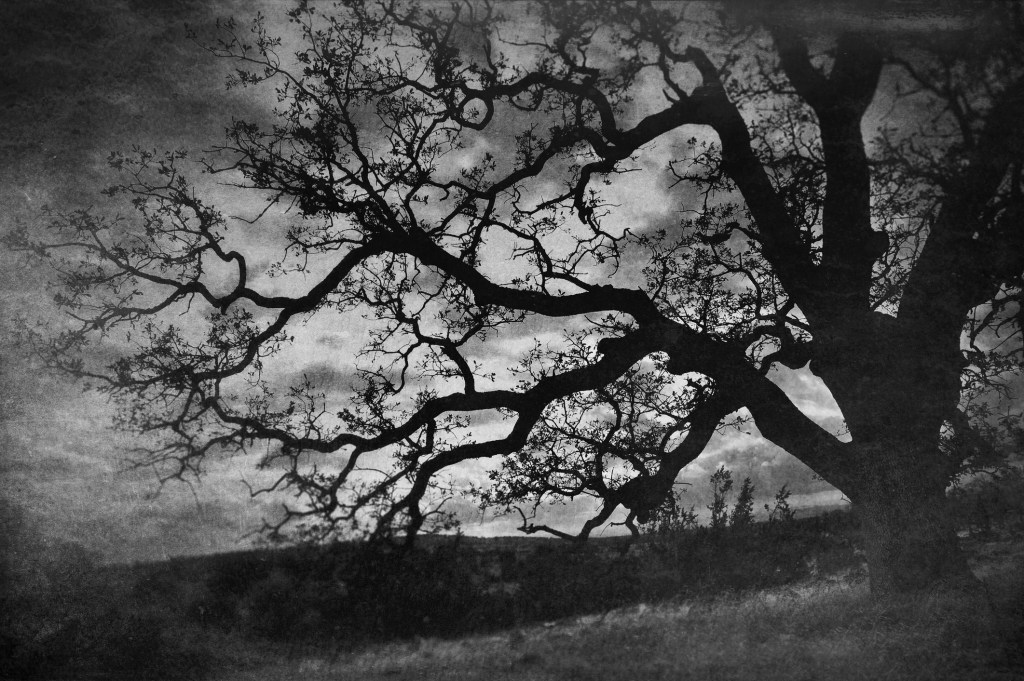
Jerald had never seen anything unusual; there was just a strangeness about the location that gave him an uneasy feeling. The place was on the right side of the road, a little beyond the rise. There was a small grove of old oak trees standing on land unusually sunken in contrast with its surroundings. The fields on both sides of the road were open and mostly flat or having a gentle slope. This place with its twisted oak branches looked closed in and always in the shadows, even in full sunlight.

Within the grove and old, dilapidated one story farmhouse stood, its entrance had long since been obscured by overgrowth, making the house seem more like an island with no noticeable access. That was fine with Jerald; he never could imagine a time where he would want to get closer to the home anyway. There was no glass in the front windows facing the road, and he often thought that someone might be standing in the shadows watching him pass.

Jerald was looking forward to getting home, his dad traditionally drove his old pickup into town, and along the way gathered Jerald’s friends. The boys joined with the children in town to Trick & Treat in areas where houses were closer together, unlike in the country. Thinking about the festivities, Jerald barely noticed he was approaching the rise in the road. Daylight had been rapidly fading since leaving the main road, and the sun was about to drop below the curvature of the earth.

Instinctively, Jerald moved from the center of the dirt road to the left in preparation for passing the old farmhouse. At the crest of the rise, a sudden wind stirred within the fields, causing the old twisted oak branches in the grove to sway against a darkening slate sky. The motion to Jerald looked like creepy arms reaching out from the shadows. Looking between the trees, he could barely see the old house.  Another rush of wind reanimating the branches revealed a slight flicker of light from within the house that stopped Jerald cold in his tracks. Starring into the grove, he saw it again; the light had a yellow-orange quality, not unlike a Jack O Lantern, and flickered like a candle.

Jerald, inexplicitly and against all logic and reason crossed the dirt road and leaned against an old fence post. From this vantage point, he could see the flickering light through one of the black window openings. Some mysterious force he did not understand was pulling him toward the house against his better judgment.

Jerald began picking his way through the underbrush toward the house, the grove being at least a hundred feet or so from the dirt road. At the point where the underbrush ended, and  the trees began, he hesitated for a minute before inching into the shadows of the trees. Everything was different here,  the air had an earthy smell, and the closed-in look he had observed from the road was exponentially worse and felt claustrophobic. Jerald could scarcely believe he was among the trees he had purposely avoided for years and within a stone throw of the mysterious house that had fueled his imagination with fear.

One side of the front porch had sunk into the ground, and the other side, still attached to the house caused the structure to look more like a ramp. Jerald started up from the low end and making his way to one of the front windows; he looked inside. The flickering light did not have one source and intermittently lit small places within the room for a brief second before showing up in another part of the room illuminating in the same way. It almost looked like small bursts of light. At first Jerald thought it might be lightning bugs, but it was the wrong time of year.

Jerald could now hear somebody softly humming, the sound coming from where an old wood-burning cookstove stood against a far wall. There was a smell of wood smoke in the room and something else – something sweet and spicy like pumpkin pie. A short shadow moving quickly along a wall to his right was accompanied by the sound of a little girl giggling. Jerald had seen enough, and his instinct for flight was on red alert. He was not looking forward to going back through the trees to escape, but staying in place was not an option.

Stepping off the porch, he tried to guess the approximate path he had taken on the way in, and at best could only manage a fast walk through the darkness. Nearly to the outer edge of the trees, he saw a small enclosure with a single gravestone marker within.  He would not have seen it except for the same soft bursts of light down low near the stone. As he hurried past toward the open landscape, he paused long enough to read the inscription on the stone. MaryJo Hawkins March 1903 – Dec 1913.

Jerald did not understand or talk about that night and what he had witnessed, but as he grew up, got married and had a family of his own, he realized the significance of his experience and the probable story behind that lonely abandoned farmhouse from his childhood.     

The Storm

Something was off; I could feel it the moment I awoke. It was a morning in mid-June with an overcast sky and oppressive humidity that felt like if I squeezed the air, it would release water like a sponge. Despite the overcast skies, temperatures still managed to climb to an uncomfortable 85 degrees by mid-morning without a hint of a breeze. My mother often hung clothes to dry on lines strung across our back yard, and when dried, the clothes had natural freshness from being out of doors. The air today had none of that freshness, and smelled of dampness and dirt.

The weather report on the radio talked about an unstable air mass that had moved into the area creating conditions favorable for storms. Everywhere I went on that morning, I felt clammy, like a thin film of perspiration covered my skin. The humid air had the effect of sucking your energy and making it a struggle to do small tasks.

Around 2 PM, the light outside changed, and darkness more closely associated with sunset descended on the streets and houses in our neighborhood. It looked like a scene from an eerie movie set where the crew and actors had left for the day.

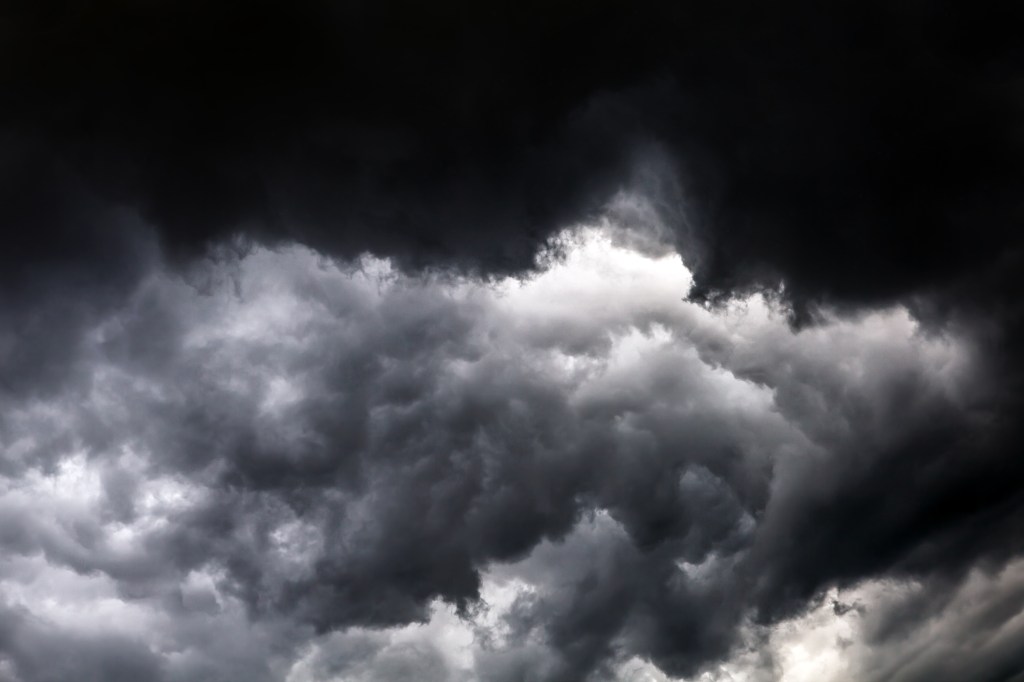
There was an unusual silence outside you don’t often experience within a city, and at first, I did not comprehend how that contributed to the strangeness of the scene. Songbirds, barking dogs, and even pesky insects went quiet and looking at the sky to the west, I saw the reason. Stacked up on the horizon were the blackest storm clouds I had ever witnessed. These were not typical gray clouds with a darker underbelly; these were black with jagged tentacles reaching toward the earth. The blackness had a dirty oily quality, almost as if the clouds had been born over some polluting refinery belching black smoke.

The sight of the ominous-looking clouds was threatening and looked like at any minute they would rain down terror and destruction on anything in their path. There did not appear to be any movement in the line to the naked eye, nor was there any rumbling from within — just angry black shapes waiting to start their onslaught. I realized the appropriateness of the phrase, “The silence before the storm,” as I marveled at the stillness of the moment.

The light in the balance of the sky took on a yellow-green cast, and houses and other objects looked surreal, bathed in the odd light with the black horizon as a backdrop. I heard my dad tell us to get into the basement but could tell he was in awe by nature’s display of power and did not want to miss what was about to be unleashed.

I remembered the large clusters of loudspeaker horns mounted to the roof of the elementary school I had attended a couple of blocks from our home. I had never heard the warning siren before, and hearing it now added a level of foreboding.

The first drops of rain that fell were large and hit the sidewalk and flat part of a handrailing with a splat that reminded me of a small water balloon bursting. Slow and subtle, the black wall crept ever closer even though when watching, it did not appear to move. A dark shadow similar to nightfall replaced the odd colored light, and a sharp downdraft instantly removed the sticky remnants of the muggy day — the temperature plunging nearly 20 degrees in minutes. At the same time the temperature dropped, the storm came upon us, and the stillness was shattered.

 The stately elms that lined the boulevards in those days before Dutch Elm Disease wiped them out had their huge limbs widely swaying as turbulent winds rushed through them. Blinding flashes of lightning ripped holes across the sky, and sharp cracks of window-rattling thunder boomed nearly simultaneously following each bolt. It felt like all hell was breaking loose above us, and rain fell in huge torrents, pushed by wind that shrieked and howled as it rushed between homes. The wind nearly ripping the door from my dad’s grip, finally brought him out of his trance, and he quickly ushered us into the basement where my mother had already taken shelter.

For the next hour as the storm raged, I listened intently for the roar that tornado survivors often describe in the aftermath of a storm. There were a couple of times where I thought I was hearing that roar, but it must have been the heavy rush of wind through the trees because a tornado did not visit our neighborhood on that day.

When the worst was over, and we emerged from the basement, the air had a lightness. The storm had washed the dirt and pollution from the air leaving it clean and fresh. The rivers of water covering the streets at the height of the storm soon reduced to small streams running near the curbs. Intermittent drops from millions of leaves fell onto car roofs, sidewalks, and the street whenever a slight breeze ran through the branches of the stately elms.

I felt fortunate that the storm had not caused more damage. I later learned the storm had spawned multiple tornadoes, and it was just luck that one had not chosen our neighborhood to unleash its destructive force.

Writing Shed

A Writing Shed

I am dreaming of a writing shed set in a shady part of our yard where two majestic oaks once stood before a storm toppled them like giant dominoes. I imagine the shed having two barn-style doors  I would open wide when writing at my desk. Sitting there, I can hear songbirds who nest in our yards many trees and shrubs. I hear water running over rocky riverbeds before dropping into deeper pools from three ponds near the greenhouse. Cisco and Finn, two Golden Retrievers who roam the property come by to check on me from time to time. If nothing more interesting is going on, they lie on the rug under my desk or stretch out on the front porch waiting to see if I throw them something to retrieve.

Windows on each side of the shed allow morning and evening sunlight to stream in, and I watch as the light moves across the rough-hewn Barnwood floors throughout the day. On breezy days, the light creates ever-changing shadow art patterns along the shed walls.

 The exterior paint is bright white with a black trim to match the main house. An oriental rug in varying shades of blue lies underneath my desk and extends several feet beyond the dimensions of the desk in each direction. The desk is an old farmhouse kitchen table made of pine, and its chair is an antique wooden swivel chair with spindle back, and wheels that roll quietly on the rug.

 Several shelves mounted to a wall behind the desk hold artifacts found in the yard with my metal detector. One of the shelves holds some of my favorite books. A modern LED task light provides a concentrated pool of white light in the center of the writing desk. The light aids me when writing in my journal or reading a book. A wooden cigar box containing my collection of pens sits on one corner of the desk.

Several paintings of oil on canvas hang on the walls depicting landscape scenes with dramatic skies. In one corner, a wood-burning stove with decorative soapstone panels sits atop brick pavers and raised tin tiles provide a protective heat shield against the wall — the stovepipe standing straight exits through the ceiling and roof. Next to the stove, a copper container loaded with split wood and tall matches in a decorative cardboard cylinder. Several large pinecones dipped in cinnamon-scented wax are scattered across the top of the wood, and used as starters.

 In front of the shed, a wooden deck with two rockers extends the width of the shed and has a step up from the cobblestone path leading to the entrance of the shed.  The deck has a metal roof that is supported by 4×4 posts along its front. Two planters filled with herbs mounted under the front windows provide a  pleasant earthy fragrance inside the space.

 A small ceiling fan hanging from the center rafter keeps air moving on warm summer afternoons. There is a small comfortable red settee in a grouping with another upholstered chair, side table, and lamp. The lamp has a beautiful stained glass shade, and in the evening, its subdued light is a perfect complement to the space.

The cobblestone path winds through a natural area of smaller trees, wildflowers, and mulch. A narrow antique side table sits underneath a window and has a propane cook-stove, several of my favorite ceramic cups, a French press, and a variety of teas. The view from the front porch is to the west across the yard facing the greenhouse with a long view of the polo field and a corner of sky where spectacular sunsets perform each evening.

Searching for Adventure

In the 1970s, when I attended high school, it was common for weekend parties to include underage drinking, mostly kegs of beer. Parties thrown by students within the school were talked up and embellished by invited kids and others who planned to show up. Hype about a party might be about its unusual location, and most tended to be outdoors. The hype, like a lot of other things in high school, was usually better than the party itself. 

Information about parties circulated through the student body around mid-week; this, of course, was before cell phones and texts. Word of mouth, written notes, and landlines were the communication network of the day. By Friday, the buzz reached a crescendo as kids desperate for weekend plans imagined themselves among the revelers.

It was interesting to see kids converge onto a party site from every direction and with every form of transportation. At our school, there were two main categories for a kid to belong to, Jocks and Freaks. Of course many kids didn’t fit in either category, and a few kids skirted the line of acceptance within both groups.

There were a couple of memorable parties with unique locations, one involving a farm where kids bused out of the city had tons of acreage, live music, and the freedom to drink without the chance of driving under the influence. Another one involved an old abandoned mansion on the hills above the Guthrie Theatre overlooking downtown Minneapolis.

There is one location though I will always remember as being truly unique. Part of its mystique was the fact that so few people had ever visited. Kids had heard rumors about the place, but few had been inside. One reason was pure logistics. Our high school located in Southwest Minneapolis was miles from the location, and a carload of teenagers bombing down well-traveled highways, with a trunk full of party supplies and fogged-up windows, was a sure way to attract the wrong attention.

Part drinking location, part exploratory adventure, and part horror show, “The Caves,” were a destination for kids looking for something out of the ordinary. Built-in the early 1800s, the tunnels reportedly run for miles inside sandstone bluffs on the Mississippi near St. Paul. Originally the caverns were mined for sand to make glass, and in the ensuing century and a half, multiple enterprises utilized the tunnels, including a businessman who built a speakeasy in the 30s that became a favorite haunt for gangsters. 

Most of the network of tunnels fell into disuse after World War II, and the city worked hard to keep entrances sealed, and young explorers out of harms way. The task of keeping people out proved to be daunting because of the soft sandstone, the same reason why they built the caverns in the first place. The soft rock can easily be carved out around any erected barrier. The tunnels became an attractive nuisance because of the mystery surrounding them.

My older brother and a couple of his friends from our neighborhood were the only people I knew who had ever been inside, and they knew of a secret route to gain access.

One Friday night, an excursion to the site was suggested on the spur of the moment and then turned into a reality when everybody agreed that it was a good idea.. A few people had been hanging out at our house, and as is often the case, decisions in the teenage world are made based on a challenge rather than rational logic.

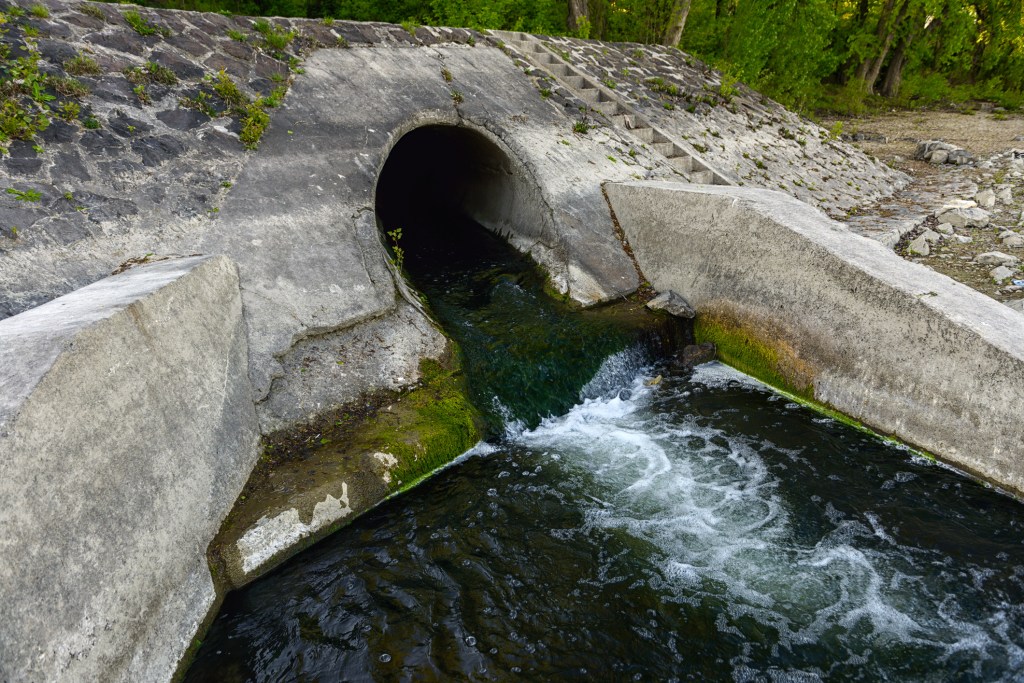
It was readily apparent as we embarked on the journey why the caves as a party location would never appeal to the masses. The logistics of accessing the caves, hauling flashlights, and needed paraphernalia for a party was not an easy task. Once onsite, the first obstacle was to squeeze through a re bar opening at the exit of a storm sewer that flowed directly into the Mississippi. The water running through the storm sewer was only an inch or so deep on that night and flowed mostly down the center of the concave sewer floor. Once inside, it was approximately one city block back from the river to the opening. Someone who knew the location of the caves, broke a hole through the concrete ceiling, and through that hole, our group was able to access the inside of the caves.

It was an amazing thing to shimmy through the hole, stand up, and realize you were in a cavern with 20 to 30-foot arched ceilings and enough width between the walls to drive a dump truck through. The darkness within the caves was absolute, and with flashlights turned off, the blackness was impenetrable. There was no such thing as waiting for your eyes to get accustomed to the darkness. There were dozens of tunnels running off of the main artery, and each was as wide and tall as the main. The tunnels all dead-ended into solid sandstone walls where previous visitors had carved out hand and footholds, allowing a person to climb to the ceiling.

Our adventure that night ended safely, but it was not too long after our visit, that we heard on the news about authorities finding an unidentified dead person within the network of tunnels. While writing this story, I searched the internet to find if anything had changed in the last 45 years, and was saddened to see five additional young lives claimed by the caves over the years. From reading the stories about people who have explored the caves, it is apparent one thing has remained the same. Young people are still looking for the same adventures we sought all those years ago.

The Girl in Rear Window

Each day was a little shorter than the previous day. My Brother-in-law, who had helped me get a job at the company where he worked, is originally from Boston. While living there, he had never felt the need to own a car. On days when I made it back to the office in time, I would drive him home before taking the scenic route past a large cemetery next to a lake as I drove toward the house where I was staying. I took solace in the scene as I gazed at the staggered monuments in the fading light of a Minnesota autumn evening.

Two months earlier, I had voluntarily separated from the Air Force after serving two, four-year enlistments. Unfortunately, as my military service came to an end, my marriage had also fallen into disarray, my wife indicating through words and actions she no longer wanted to be constrained by the burdensome rules of marriage. I remember it being a devasting time; as if someone had sucked the air out of the room, making it hard for me to breathe. Over the next weeks, I could only manage the same two or three thoughts as I tried to make sense of what was happening around me. Thoughts ran in a circular pattern, and I feared they would eventually cause permanent brain damage if allowed to continue. My self-esteem took a beating from subtleties hardly noticed at the time, but once removed, taking months to recover.

It was under these circumstances that I tried to adjust to the civilian world; the military was a different kind of life. With no real prospects for a decent job where I lived, I left my wife and young daughter and returned to my hometown of Minneapolis, with a vague promise from my wife that she would follow  once I found a job and housing.

The job I secured in Minneapolis required a fair amount of travel within the state, with a territory encompassing most of St. Paul, the northern suburbs of Minneapolis, and any town between the cities and the Canadian border big enough to have a hospital. The equipment I maintained was used mostly in hospital admission offices, and that fact was a blessing for a directionally challenged person such as myself, because of the conveniently placed blue hospital signs.

The driving in winter was often treacherous, and I remember returning from Hibbing, a town in the northern part of the state. The blowing snow on the secondary road I traveled obscured the center line and shoulders to the point where I no longer felt confident I could follow the contours of the road. The storm forced me to find a hotel in the next town to wait it out.

Many of my working days were long because of the size of my territory, and It was not unusual to return home after 9:00 or 10:00 PM after having started at 8:00 in the morning. As a tech, I carried a trunk inventory of spare parts, but if I did not have the right part, I would stay overnight until the office could ship the part on the next Greyhound bus passing through that town.

I enjoyed the time spent on the road; it gave me time to think. I knew there was a hole in my life without my family, and every day I missed seeing my daughter. Everything else in my life was going well; I had a good job, and I was living in a place I loved and where I had the support of family and friends. But my life and marriage were unresolved and kept me in limbo, even though I believed in my heart, the relationship was over.

Talking with my wife during this time, I could tell she was purposely delaying the process of selling our home, and dragging her feet in her previous commitment to reunite our family. Every week it became clearer that she had no intention of moving back, and now having established myself in the area, I was leading an emotionally draining existence.

Winter turned to Spring, and Spring turned to Summer, and I listened to the smooth guitar work of Dire Straits on Romeo and Juliet as I drove between calls on summer afternoons. Summer began edging toward fall, and the first anniversary of my return was fast approaching. It is the subtle things you notice as seasons start to turn and you become aware of the passage of time. Like the way, the light has a little more texture in the golden hour near sunset, or how the temperature dips an extra couple of degrees in the morning before sunrise.

It was a normal early September day, and I was taking calls locally. I had completed a call at a downtown St. Paul hospital and was now making my way along a main artery toward the freeway. As I drove, there were traffic lights every few blocks, and each one turned red before I reached it. About a half-block before the next light, a car passing me on the left pulled into my lane and stopped ahead of me at the light. I slowed and stopped the normal distance behind the car, and as I waited, an unrestrained little girl in the backseat of the car in front of me raised her face above the seatback and stared back at me.

There was something in her expression, where I could not look away. She was not smiling or making child-like faces; it was an expression conveying a question, the question of why. I watched her for what seemed like minutes, and all the while she looking directly in my eyes, never wavering. When the light changed, the car turned right, and I continued straight. Looking to the right as I passed through the intersection, I could still see her small face staring back at me.

I drove another couple of blocks before the significance of what I had witnessed hit me. The why became crystal clear, I had seen my daughter in the face of that little girl, and she was asking why I had left. Her voice in my mind was as plain as if she was sitting in the passenger seat telling me she needed me back in her life. The decision had never been clearer. I had to go back. It didn’t matter that I had created a new life in a place I loved or that a whole set of other problems would be waiting for me upon my return. It was no longer a choice; my daughter needed her Dad.

Panning for Gold

Today I awoke to fog and cold; weather changes quickly in a northern climate.  A week earlier, when I visited the rapids, it had been a picture-perfect fall day. It was the kind of weather people in these parts call Indian Summer. I had been searching for a place to pan for gold and found a stretch of rapids on Google Earth that looked promising. The rapids looked to be pretty remote; the closest access point an old logging road coming within a mile or so of the stretch.

On my first visit, breaking a trail through the woods from the road was relatively easy. The underbrush was not too thick, and the hardwoods and pines spaced far enough apart for easy passage. I carried a small backpack with some trail food and water with my pans lashed to the outside of the pack. I had pulled my car into the tall grass on the side of the logging road and looking around, tried to find a marker that could help me relocate it when I returned. Not seeing anything useful, I locked the car and made my way into the woods.

After ten minutes of walking, I could hear the sound of rushing water in the distance, and upon reaching the river’s edge, I found my location to be near the end of the stretch of rapids I had seen on the map. Here, the water was smooth and flowed quietly down a gentler plain. The river bed was shallow, and the clear water revealed a bottom of large flat rocks with sand and river rock patches in between. The water coming down the rapids made a pleasant sound, and its pace seemed leisurely as it flowed between and over boulders strewn along the several hundred yard stretch of falling elevation.

Untieing my pans, I put on my water shoes and made my way toward the middle of the river bed. The water was 12 to 18 inches in depth with some deeper pools further downstream. As with most of my panning experiences, I spent most of the day sifting through sand pebbles, and rock scooped from the river’s bottom with no trace of the elusive gold I was after. The beauty of the day, the seclusion of the site, and the sound of the water flowing along the rapids still made the outing worthwhile.

When the sun began to sink below the trees, it put the river bed into shadows and was a sign that I needed to start packing up before it got too dark. I had just filled my pan with the raw materials of river rock and sand from the area I had been working for the last hour. As I  swirled the content of the pan, I partially submerged it into the current so that it could carry off the lighter particles of sand and smaller lighter pebbles. When I lifted the pan out of the water and began to swirl the remaining contents, I saw a flash of gold from within a clump of larger pebbles. I carefully lowered the pan back into the current, and another cloud of sand and small pebbles floated away downstream.

This time as I raised the pan out of the water, the gold I had seen had separated from the other pebbles and was sitting on the bottom of the pan. It was about the length of a dime and about half of its width with deep black creases, which only served to enhance the brilliance of the gold of the rest of its surface. Picking up the piece, I noticed it was heavy for its size, and could scarcely believe I was holding the real thing. I had seen a lot of gold nuggets in pictures, and what I was looking at matched those pictures exactly.

The sun sinking lower, now cast a dark shadow over the entire river bed, and the water looked less inviting than when I had first arrived. I made my way to the shore and retrieved my pack, and started back in the direction of the road through woods. Hopefully, I would come out somewhere in the vicinity of my car. I did not want to be navigating the woods in darkness.

From everything I read, there was a good chance more gold could be in the area where I found the first nugget. Today was my first opportunity to make a return trip to the river since finding the nugget. The weather forecast called for more of the cold rain that had been falling intermittently for two days. A dismal forecast was not enough of a deterrent to dissuade me from the possibility of finding more gold, though. I packed additional clothes because of the cold, along with a waterproof poncho that would allow me to work in the rain.

Reaching the location on the dirt road where I had parked before, I carefully checked my supplies before starting my trek through the woods. This time, as I made my way into the woods, I noticed I could hear the rapids after only a few moments of walking. Everything looked different today; the grey clouds cast a depressing pale on a scene that had been sunny and cheerful on my first visit. The roar of rushing water was louder and more powerful than I had remembered, and as I got nearer to the edge of the river, I was second-guessing whether I was even in the right place.

The stretch of rapids I saw now from between the trees, did not have any resemblance to the place I had visited the previous week. It had not occurred to me that the rain we received locally was also falling across the state, and causing creeks and rivers to swell. Standing at the edge of the woods, I did not dare go any closer. The water careening over the rapids had an urgency to its motion as if reaching the next fall was paramount for its survival. The surface of the water between each fall is frothy and agitated as if being boiled, and then turning smooth when moving into next fall; the waters surface reflecting the dark rocks underneath. Silver ribbons of water reflecting the grey sky had the look of glass and intertwined with the darker water giving the flow depth and dimension.

The roar of the water moving through the rapids was powerful like standing near a railroad crossing as a freight train passes at full speed.  I moved in the direction of where the rapids ended, staying inside the tree line to guard against slipping into the torrent. The river flowing out from the rapids had doubled its width and was threatening to overflow its banks. The area I had been standing in when I found the gold was now several feet deep with swiftly moving water rushing downstream.

Finding a fallen tree along the embankment, I sat and watched the seemingly endless supply of water tumbling down into the river bed and lamenting the fact that searching for more gold was not going to be a possibility today.

My Camden Home

Fences run for miles enclosing manicured fields, where empty bleachers and outbuildings dot the landscape. The flat green fields stretch across large expanses as far as the eye can see. Church steeples framed against a blue autumn sky attest to a small-town feel. Antebellum mansions line shady streets where paths rather than sidewalks pass in front of wrought iron gates, stone and brick pillars, and ornate white wooden pickets. Open front porches, comfortably furnished, provide occupants a quiet place to enjoy a cool evening.

Narrow streets running through hidden neighborhoods present visual surprises twisting and turning for a person on foot, not in a hurry. Large grassy squares with benches under Live Oaks offer respite for a weary walker. Streets named for generals from long ago battles mostly forgotten — historic markers attempting to recapture their story of time and place. An old Polo Field silently awaits the return of teams mounted on horses and the excitement of competition. History abounds everywhere you look, and one wonders about a staircase ascending into an empty lot, or a meticulously built perimeter wall, that now only surrounds scrub bushes and weeds.

Ivy climbing to the furthest reaches of ancient trees also wraps itself around light poles and globes giving stately entryways the look of an old English Inn. Luxurious hotels once catering to wealthy northerners who adopted the area as a winter playground are but a memory now. One can still hear the passenger train whistle in the early morning hours, and imagine a time in the early 1900s when stylishly dressed passengers disembarked with their trunks and belongings for extended stays.

Elegant streetlamps line the main road leading into town passing historical sites along the way. Reaching the center of town, an iconic statue of an Indian, his bow drawn, can be seen atop an old clocktower. A former historic library now houses an archive of books, documents, and materials that tell the history of the place.

Tours each holiday season give people a glimpse of the beauty and craftsmanship of historic homes. The homes bridging a connection to the past, are a testimony to a time and lifestyle from another era.

Each spring the town’s population swells tenfold for the world-famous Carolina Cup Steeplechase. Powerful thoroughbred horses run the course as ladies in fanciful hats, and gentlemen in their finest enjoy the party atmosphere and excitement of the races.

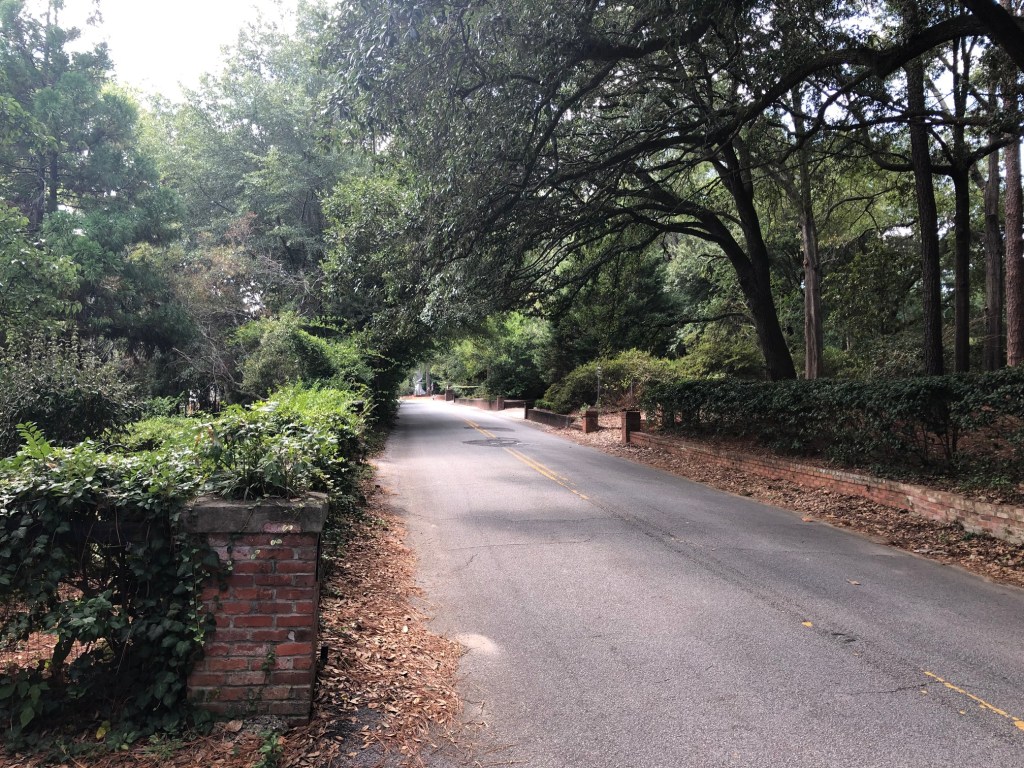
And each day as I drive down a tree-lined street where branches form an arch reminiscent of a cathedral, I sense the history and passage of time around me. And I always look forward to returning to my Camden home.

F4 Fighter Flight Line

When I saw the flight line for the first time with its artificially lit surfaces and the F4 fighter jets perfectly aligned in three rows stretching the distance of a city block, I was in awe. Four double-wide trailers stationed behind the jets sat evenly spaced over the same distance. The jets, facing away from the trailers, were parked at a 20-degree angle. The trailers housed the maintenance crews responsible for keeping the jets flying, and a dispatch coordinated all of their activity.

I was eighteen years old in 1977 and had just arrived at MacDill Air Force Base in Tampa, Florida. MacDill was a pilot training base in those days, and as I was soon to find out that meant a lot of missions flown, and around the clock maintenance to keep all those fighters in the air. MacDill was my first assignment after basic, and a 13-week training school in Denver, Colorado.

Standing on the tarmac next to the jets for the first time, I found myself wondering how something so heavy with such a small wingspan could ever achieve flight. Later, when witnessing for the first time a group of four thundering down the runway in pairs,  I understood. The two enormous engines propelled the craft more like a rocket and flight appeared to be achieved through sheer brute force of overwhelming thrust; with afterburner flames lighting up the night sky. I became thoroughly impressed by the brave pilots who sat atop those engines and rode those beasts into the sky.

The incoming recruits arriving on the base allowed troops with more seniority an opportunity for better shifts, with the newest arrivals relegated to swing-shift or mid-shift. I started on mid-shift and tried to get accustomed to my strange new environment.

The flight line was a place in constant motion and endless noise. JP4, the jet fuel used by the fighters hung heavy in the air. There were gas-powered lighting units trained on the sides of jets receiving maintenance, creating islands of light brighter than daytime. Huge custom generators used to simulate voltages achieved during flight, let ground crews operationally check systems. The plug from the generator that attached to the bottom of the jet was as thick as a person’s leg, and when cranking up, sounded similar to a jet engine, their noise adding to the chaos of the place. In addition to all the people on the tarmac, a constant parade of support vans, towing vehicles, security pickups, and countless other equipment zigzagged its way between the fighters. 

It was a dangerous environment filled with sharp surfaces, low clearances, heavy equipment, dangerous materials, heat, and fatigue. I could feel heat stored in the thick cement of the tarmac being released back into the night air after an exceptionally hot summer day. The base, surrounded by the water of Tampa Bay, gave the air a salty brackish smell that was more unpleasant at low tide. Heat lightning within thunderheads usually over the gulf provided spectacular light shows.

The fighters sitting motionless waited through the night as crews scurried under, around, and inside, checking, and double-checking their systems. Each night was a choreographed dance of experts in every discipline, fighting the clock for when the pilots arrived, and it was time to fly.

All procedures in and around the jets required a checklist, and each task required a specific order in which steps within the task were carried out. The checklists ensured all steps were completed and kept the maintenance crews safe from preventable mishaps.

I was the number four man on a weapons crew of four men. One of my main jobs was to drive a bomb lift vehicle used to load weapons onto the fighter. The vehicle, affectionately known as the Jammer, was essentially a forklift built in a low horizontal fashion that enabled it to slide beneath the low clearance of a fighter jets belly. The table of the Jammer had hydraulic controls for fine adjustments and allowed the crew chief to guide the munition precisely into its position on the fighter. Driving the Jammer underneath the jet to load the larger air-to-ground missiles was challenging for someone of my height, and I would have to duck my head down nearly even with the Jammers steering wheel when loading the missiles at the rear of the jet.

It was all pretty overwhelming at first and later became the norm as I spent the next eight years of my life working in an around fighter jets. Hundreds of pilots cycled through training during that time, and many probably went on to fight in Desert Storm.  Within that loud, noisy, dangerous environment, there was also beauty in the gentle rains when reflected just right reminded me of a Minnesota snowfall. Or the incredible sunrises, and spectacular thunderstorms. And at the end of the shift, arriving home exhausted from the night’s work, seeing my baby daughter Lana who was always happy to see me come home.