A Story of Lost Treasure

May 5, 2020.

The sound of a door hitting the frame on an abandoned shack from wind sweeping through the valley is lost in desolation. The tiny building’s floor, littered with old whiskey bottles, empty food cans, and rusted tools, provides a window into its past inhabitants. Sonny Chance sits on a weathered piece of wood, once a part of the shacks cladding, now balanced between two rusty pails. Staring at the floor, he watches a shaft of light that widens and narrows in sync with the swaying door, blue smoke curls around his prematurely weathered skin.

In quiet times, voices and faces of disappointment haunt him. He no longer has the stomach to look at the destruction in the wake of his compulsion: a failed marriage,  lost career, and financial free-fall.

Three years ago, Sonny succumbed to a fever inflicted on treasure hunters, the kind of fever that gets under your skin and won’t let go. He found a hand-carved walking stick mixed in with cheap umbrellas at a yard sale in Minneapolis, and the item turned out to be old. Experts at the University of Minnesota believed the carvings to be the work of the Lakota Sioux. During their examination, they discovered something else, something that would forever change the course of his life.

Running his fingers along the body of the intricately carved stick now, he slides it apart, revealing the hollowed-out portion containing his obsession. Removing the thin animal hide from the compartment, he unrolls it for the thousandth time. The soft leather stained with plant-based pigments renders its image in muted tones. The scene of a large meadow in the foreground of purples and browns slopes sharply toward a distinctive rock outcropping. Above the ridgeline, the sky in pale gradients of whites, yellows, and blues is indicative of a setting sun. Four words in Lakota are written near the bottom, “Place of yellow metal.”

In the 1870s, a gold rush brought thousands of prospectors to the Black Hills of South Dakota, even though the Laramie Treaty of 1868 recognized the land as part of the Great Sioux Reservation. To the prospectors, the treaty was an inconvenience, an obstacle, in the way of riches that most chose to ignore. There are reports of missionaries as early as the 1850s who witnessed  Indians carrying gold that they claimed had come from the Black Hills. Sonny believes his artifact dates to those earlier years.

Being the first week of May, mornings in the Black Hills can still be near freezing, and Sonny, starting early, has searched for several hours by mid-morning. He uses old trail maps and a compass for navigation, no longer owning a cell phone. He estimates his location somewhere between eight and ten miles west of Crazy Horse.

 Following the banks of Loues Creek, he sees the side of an outcropping on a high hill in the distance. Leaving the creek bank, he angles through the pine forest in the direction of its base. According to his compass, the outcropping faces east, which he believes is a prerequisite for the location of the painting. He finds the shack at the bottom of a smaller hill in the valley between his destination. The place looks like an old mining operation with abandoned narrow rail beds for hauling rock.

Sonny, essentially homeless, carries his possessions inside a large backpack, the type you see thru-hikers use on the Appalachian Trail. When food and tobacco run low, he picks up odd jobs in the small towns that dot the Black Hills until he can resupply. Adept at living in a tent, he treks through the seemingly endless hills searching for the location of the painting. His lifestyle works in the summer months, but winters in these parts are not survivable outdoors. He awkwardly spent the past winter in his daughter’s house basement in Minneapolis but is confident she isn’t inviting him back.

Seeing potential in the shack as a home base, he figures by traveling lighter; he could cover more ground. He estimates it is another mile or so to the front of the outcropping and, taking out his flashlight and a fresh pack of smokes, slides the backpack and cane behind an old workbench against a sidewall.

Back outside, he breathes in the fresh scent of pine forest floors warmed by the afternoon sun. Wildflowers are flourishing in sunny patches along the tree line, and insects are moving as if making up for lost time. Everything around him is coming to life after the long winter.

Navigating through the valley is easy in the flat land meadows with a sparse cover of trees. Looking up periodically, he sees the rock face set against a perfect blue sky, revealing itself slowly the further he travels to the northeast. Cutting over to the hill’s base, he starts up the incline at an angle, gaining elevation while still working toward its facing side. The forest’s density returns on the hillside, and he can no longer see the rock outcropping through the canopy.

With the steeper incline, he grabs pine branches and exposed roots as handholds to pull himself along; the millions of needles create a slippery surface. The light under the canopy is dim, except for a few shafts of light that have pierced small openings.

Abandoning the angled approach, he now climbs straight ahead, and several hundred feet above him, there is a stark brightness along the entire width of the treeline. Approaching closer, it looks as if the trees abruptly end, with the land opening up beyond.

For Sonny, reaching the line and stepping into the sunlight is like stepping inside his painting. A wave of excitement washes over him as he realizes everything is in its place. The tall grasses infused with thousands of indigenous Darkthroat Shooting Stars render the meadow in a purple hue. The outcropping reminds him of a skeleton key with two higher columns like bookends, holding a jagged set of smaller peaks. With the sun still above the ridgeline, it is not hard for him to imagine a pale pastel-colored sky when it sets.

Sonny crossing the meadow to the base of the rock, places his hand on the cool surface of the granite. Slowly walking the width of the rock base, he runs his hand inside small crevices and inspects the rock for signs of shiny metal. Standing in the majesty of the place, he feels connected to its history.

Not finding anything, Sonny takes a breather on a ledge between one of the broader crevices forming a deep V into the rock. There is a young pine tree seemingly growing directly out of the rock wall inside the V, its exposed roots clinging to the tiniest of cracks for survival. Firing up a smoke, he looks out at the expansive view of the valley and beyond.   

Standing up, Sonny looks back into the deep V and blows a stream of smoke from the last drag of his cigarette. The smoke floats leisurely in the still air and suddenly rises rapidly. Sonny squeezing into the crevice, feels a cool updraft coming from the rock floor. Crawling on his hands and knees, he shifts loose rock around, and the stream of air increases. Using one of the loose rocks as a bludgeon, he enlarges an opening to a point where he could slip through. Shining his light in the hole, he sees a workable pitched surface descending to the cave’s floor. With the butt end of his flashlight, he prods the exposed earth below the removed stones and can hear the echo of dirt falling within a chamber below.

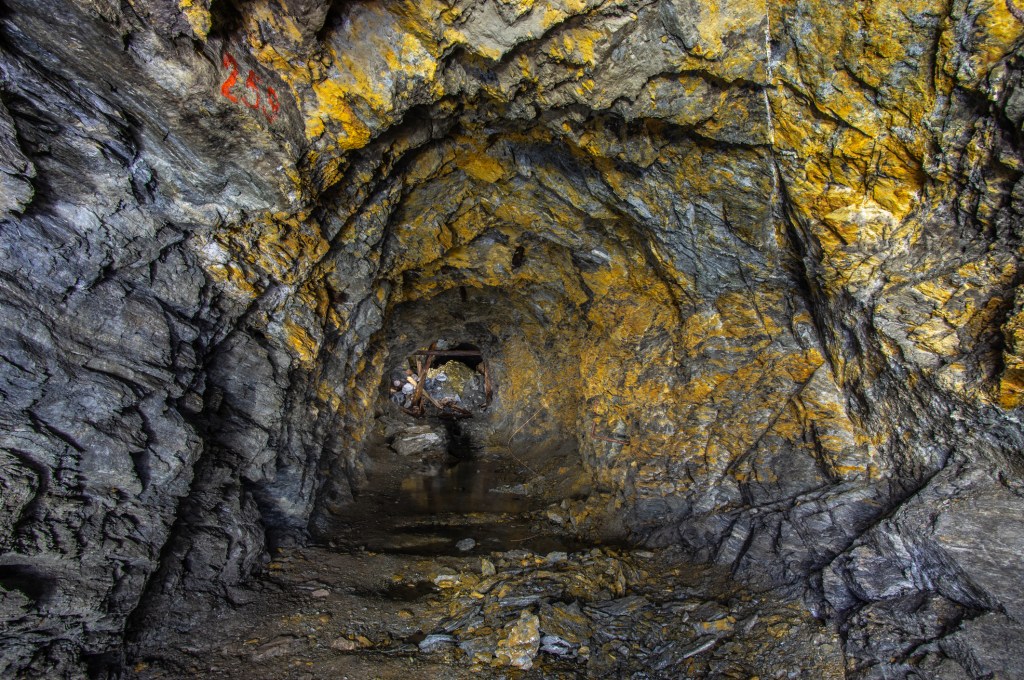
Sonny knows the dangers involved with cave exploration, but the excitement of the discovery overrides his usual caution. Slipping through the opening, he turns on his light, half scrambles, and half slides his way to the cave’s floor. Shining his light around the bowl-shaped space, he sees flashes of exposed gold everywhere, like someone took a brush and started flinging gold paint. The chamber, probably once a raging river, was cut into a U shape as the water channel around the curve wore the walls smooth.

Walking along the inner wall, Sonny reached up and started tracing a vein that varied in width from four inches to over a foot thick. Training his flashlight on the mesmerizing color, he follows the wall’s curvature, trying to imagine the value of what he was seeing.

He realizes that he has made a fatal mistake in a fraction of a second. Like slipping on black ice where one finds themselves on the ground before they even know they have slipped, Sonny’s next step is met with only air, catching him completely off balance. Sonny grasps the emptiness before him as he falls into an unknown void. The spinning beam of his flashlight flung from his hands in desperation is the last image he sees before total blackness.

Sonny did not know how far he fell, but it didn’t matter; landing on jagged rocks, he was broken in many places and understood he had found his final resting place.

Nov 30, 2020.

Black Hills Chronicle

From Rapid City, SD, David Tillis was searching for the opening of the Loues Creek mine in a remote area west of Crazy Horse when he discovered an old Lakota carved walking stick in an abandoned shack. The carved stick had a secret compartment containing a rare leather painting. Experts authenticated the artifacts dating to the mid-1800s, and a NY auction company hired to sell the lot has set a reserve of 1.2 million dollars.

An Opening

An Opening

There is a story from my childhood that I have never told, a fantastical tale that I know to be true, even though the passing years have undoubtedly obscured some details. I have kept the story close during my lifetime because of its unpleasant nature, but I am now prepared to account for the events.

My name is Toby Clark, and in 1968, I was an ordinary kid living in an ordinary town with an extraordinary problem. Having just turned ten, I was the only child of a middle-class family. My dad, Steve Clark, was a mechanic working for the town’s only car dealership. My mother, Mary, worked part-time in a bookstore near the town center.

The small town of Stark, aptly named, had nearly 5,000 inhabitants and was built on a flat midwestern plain resembling an island of homes and streets surrounded by an ocean of corn. No interesting features made up the town with even less of interest to do. People who lived there complained of a wind that never rested. Its unsettled nature, irritating to many, became hauntingly unbearable for me.

I was a frail child who had fallen ill with the flu right before my 10th birthday. After spending three days in bed burning with fever, fighting chills, and battling nausea, I woke on the fourth morning drenched in sweat with a feeling of lightness. A tremendous internal battle fought, the combatants weary, had left my body.

On the last night of my illness, blackness from both sides, like thick curtains closing on a final act, narrowed my vision of the incoherent dreamscapes beyond. I felt darkness around me and wondered if my defenses had nearly lost the battle.

Frailer and more diminished, I lay still watching the motion of the sheers where my mother had cracked open a window. Although too close to the source, a sick smell permeated the room. During this in-between groggy state, I heard the first strange voice. “You’re better; you’re better.” Not a question or a statement, more like a rote affirmation lacking emotion or conviction. The words whispered were faint but distinct, repeating in sync with the billowing of the translucent material. Exhausted and unable to think, I drifted off.

In the coming weeks, I found it difficult to remember when the wind was just a sound of nature. Now, every light breeze manifested into whispers that ramped up into angry shouting during storms. The words were often incoherent ramblings and, other times, chilling and commanding my attention. There were hundreds of voices, and their onslaught on my psyche was relentless. I tried everything to escape, but nothing drowned them out for long.

I remember when it started, watching the expressions of people around me and realizing in horror that I alone could hear them. I desperately wanted to tell someone, anyone. Each evening, my dad seemed unapproachable, looking exhausted and sitting hypnotized by the television. My mother, who rarely smiled, and had a habit of berating me for not being like other kids, was out of the question.

When possible, I stayed indoors even though I could still hear the voices sounding like a room full of incoherent conversations. When riding inside a car, the sound mimicked a radio tuning knob turned quickly through the AM band-only single words or partial words were distinguishable. The multiple tones and pitches are a disturbing reminder of the number of otherworldly conversations on the air currents.

There was chaos to my days, forcing me to seek solace wherever I could. Sometimes there were no words, just laughter or breathing at night, that never failed to raise hairs on my neck.

On days with gentle breezes, words were whispered, lending them a sinister secretive feel. Many dealt with people performing bad deeds, “Brad is bullying Christopher, Shelia is drunk, Marge is cheating on her husband.” Other times they spoke of people alone and scared in desolate places. “Elizabeth is lost in Baker Wood.” The latter gave me an uneasy feeling about the person’s welfare.

Typical for my age, I disavowed any unnecessary affiliation with my parents when my friends were present. Still, on days when I was alone in my room, I felt better if I could hear my mom rummaging about in the kitchen.

As spring turned to summer, the hot wind pushed slowly across concrete sidewalks and softened tar in the streets—distant lightning in the evening, the only hope of relief from the sticky air.

Much of the clutter and randomness of the voices fell away as summer progressed, leaving only the lonely voices weak and breathless like the slow-moving air. The whispered words often left me frightened and helpless. “It’s dark; I am cold; I want to go home.”

One of the voices I believed to be of a young girl had a hollow quality to it, and something else in the background I couldn’t make out. I heard her mainly in the evenings, and on this particular night, after closing the lid on the garbage container and hurrying toward the house, I heard her cry for help. It didn’t come from any particular direction; the voice came out of every dark and gloomy corner in the alley. Exasperated, I  muttered under my breath, “who are you?” And out of the darkness, her meek response of “Elizabeth Stemple” scared me badly. Panicked, I sprinted the remaining distance to the door, jerked it open, slammed it shut, and stood with my back pressed against it.

I  shuddered to think that conversation might have always been an option. Since the beginning, however discomforting, the voices had allowed me a level of detachment, like eavesdropping on invisible people. This new and unwelcome development was something else entirely.

Each year as the July 4th holiday approached, a profound sadness would seep into our home and disrupt routines, especially those concerning my mother. My dad awkwardly tried to fill in by fixing TV dinners or bringing home fast food. During this time, my mother rarely left her room, and if she did, she would wander through the house in her nightgown, clutching a worn leather binder. Conversations between my parents were hushed like the voices in church before service started.

I had never seen what was inside the binder, and it only ever appeared during this time of year. Things returned to normal after a few days, the sadness dissolving into more general unhappiness for my mother.

On Monday morning, July 8, I woke to a silent house, and on closer inspection, the sad time appeared to be ending, and routines, like going to work restored. A note held to the fridge by a magnet in my mother’s handwriting stated she would be home around 2:00 PM. Returning to my bedroom, I hesitated outside my parents’ open doorway and saw the leather binder lying on her nightstand.

Carefully carrying the binder into the kitchen, I set it on the counter. Opening its cover revealed a yellowed newspaper clipping inside a plastic sleeve. A picture between the headline and text showed two young girls in the same patterned dresses smiling out from the page—each girl looking like a replica of a young version of my mother.

Reading the headline,  “Identical Twin Elizabeth Stemple Vanishes During Fourth of July Celebrations,” my hands trembled, a coldness like the chills moved through my body as I grasped the inevitability confronting me.

At 2:00 PM, with a tear-streaked face, I stood exhausted and empty, a few feet inside the kitchen door. Clutching the binder in both hands, I heard my mother arrive and braced myself with the small amount of strength remaining inside me. Watching her expression as she opened the door, I saw a flicker of anger when seeing the binder. Her anger turned to compassion at the sight of the vulnerable child standing before her.

“Nobody took me – nobody hurt me,” I said in an unrecognizable voice, sounding hollow and distant. Her eyes filled with tears, and an unspoken awareness passed between us.

“It was my fault –  I made a mistake,” the words flowed through me.

Her eyes searched my face with an intensity I had never experienced, like a veil had lifted, allowing her to finally see the little boy, her son, for the first time.

More words came through.

“I couldn’t get out; I tried, the water came fast, trapping me, I tried to climb, I never meant to leave you, I tried.” The words trailed off into silence.

Rushing forward, she wrapped her arms around me and could only manage “I am so sorry,” over and over between uncontrolled sobbing.

That evening near sunset, sitting outside on the front steps, I watched a copper spinner on the lawn, its two wheels moving in opposite directions in the steady breeze. It was a quiet evening, with the only sound,  a slight metallic ticking from one of the wheels being slightly out of balance.

Superior

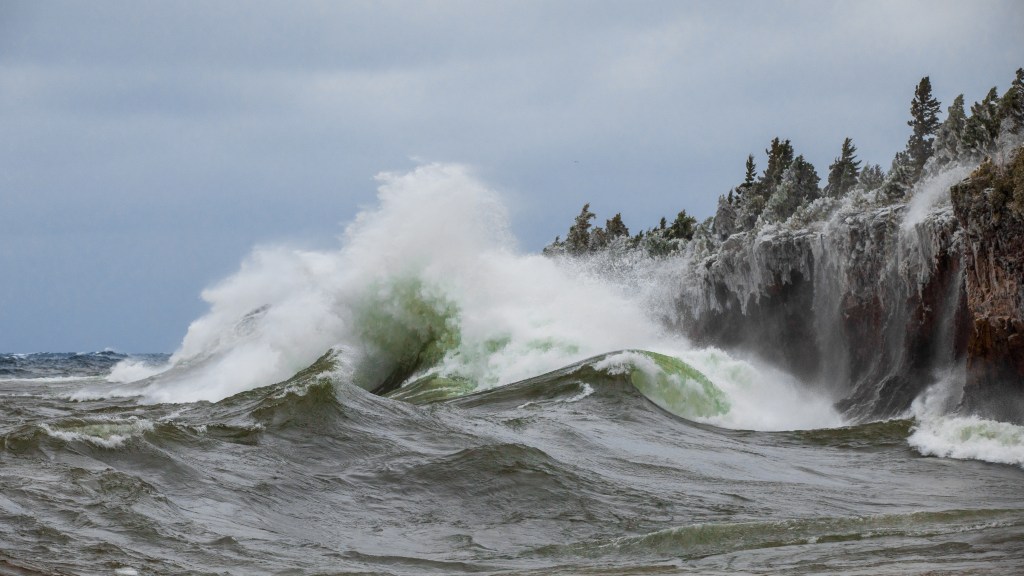
I have seen the fury of this inland sea; her rollers piled high in November gales

I have heard her thunderous chorus along the North Shore, craggy and hard against the assault

I have felt her frigid spray on top ten-story cliffs jettisoned skyward by mighty collisions

I have listened to sobering stories of shipwrecks and ten thousand souls down in her depths

I have marveled at her serenity in calmer times, always respectful of an untamed spirit

I have breathed the scented air of pine and birch forests hugging close to her rugged shore

I have watched the magical lights in the north dancing along her horizon

I have looked into the depth of the stars and galaxies hinting at the universe above her body

I have stood on her shore staring into the past, a primitive vastness unchangeable by man

And I find an inner peace whenever in her presence

Desolation

There is probably no other town within 500 miles as unremarkable as Calvington, Minnesota. Todd Birch could attest to that; he had lived here his entire life, all 13 years. Farmland was his view in any direction, and the flatness made the sky a dominant feature—all that blue making the town even more insignificant if that was even possible.

A two-lane highway split the town in half, running for a five-block stretch comprising Calvingtons Main Street before fading into a mirage in the distance. There are only three buildings on Main Street that might one time have qualified as businesses; today, they are empty placeholders from another time. Todd’s home, standing at the end of a two-block street, butts up to farmland. The field, covered in large leafy plants, march in neat rows up a slight incline to a small ridge in the distance.

When Todd steps out the front door each day, he immediately feels depressed about his monotonous surroundings. At some point, after standing on the home stoop for several minutes, he invariably makes his way the two blocks to the highway in hopes of discovering something – anything, of interest. Each time though, desolation greets him, and the cycle of feeling sorry for himself begins anew. What possible trick of fate has stranded him in such a place?

 A few other shabby kids significantly younger than Todd face the same danger as him, living in Calvington, and dying of boredom. All the kids of school age ride on a dilapidated bus that is hard to imagine ever new. The bus brings the kids 15 miles south to a larger town with middle and high schools. Todd looks forward to the start of school each year and dreads the endless days of summer.

Standing on the edge of the highway, he sees the heat rising off the asphalt in the distance. Gently he cups his right hand to protect the Chesterfield he took from his mother’s open pack. Putting it between his lips, he flips open his Zippo lighter and lights the end. The lighter, one of his prized possessions, has a solid feel; he loves the smell of the lighter fluid and the satisfying clicking noise it makes when opening and closing.

He takes a long drag and inhales deeply before exhaling through his nose. He always gets a bit of a head rush whenever he has not smoked in a few days. He has limited access to cigarettes, and the ones he steals need to be from packs with enough remaining not to draw attention.

Usually, he would find an out-of-the-way place to shield himself from view when smoking, but the emptiness of the town today is so complete, he doesn’t see the point. Walking across the two lanes, he peers through a filthy window into a hall with a for rent sign taped to the door. He can not imagine anyone wanting to hold an event in this town, and as far as he can remember, no one had.

Sitting on the window ledge, he smokes the cigarette down to the filter before flicking onto the sand and dirt of the parking area. He doesn’t own a watch but figures it can’t be much past 10:00 AM, and he has no clue how to fill the rest of the day.

Todd, hearing an eighteen-wheeler in the distance upshifting gears, thinks it an odd sound since the 15-mile approach into Calvington is a wide-open highway, and trucks’ only gear change is when approaching the town to downshift before rumbling through at 20 or so mph over the speed limit.

Todd, standing in the middle of the highway, looks south where he heard the sound; not detecting any movement, he continues across, making his way toward home. He senses or maybe feels a low rumble, and reaching the end of the first block, turns back toward the highway just in time to see a massive truck rolling slowly through the intersection. All in shiny black, the monstrosity has cowlings so low he could not even be sure it was moving on wheels. Shortly after passing from sight, the rumbling subsided slightly, and he did not hear any of the usual upshifting that would be needed to regain highway speed.

There was no way the vehicle could have exited the town that quickly; the highway to the north was flat, and anything moving you could see for miles. Todd jogged back to Main Street and didn’t see anything moving in either direction. Walking the five blocks to the north side of town, he started to question whether he had seen the vehicle at all.

Reaching the end of town, he turns right and makes his way toward home; he takes the back street bordering the farmland. As he approaches the end of the two-block stretch, he notices something different about the field; coming closer, he sees what did not look right. Two large tracks with deep impressions have crushed the leafy plants across the area and up an incline before disappearing on the other side of the ridge. The colossal vehicle has not left town; for some reason, it was out on the land.

“Wow,” Todd said under his breath, “this is weird.” The houses behind him had their shades drawn down so that no one may have seen the truck. Todd looking at the crushed vegetation, figured the landowner would be pissed when he saw it. His impulse was to follow the tracks but thought it might be wiser under cover of darkness. He had no idea who these people might be.

Back at home, Todd looked for anything besides his chores to pass the time until nightfall. What was incredibly annoying was the length of the summer days, which were like adding insult to injury.

Finally, sunset approached, and the day’s light faded; Todd watched from his second-story bedroom window as the fields became covered in darkness. He grabbed the six-cell flashlight from his desk and turned it on and off several times, ensuring the batteries were still good. Feeling the Zippo lighter in his pocket, he hoped he could swipe a couple more smokes on his way out for the adventure.

Todd had become accustomed to going alone, but he would have loved to have a partner tonight. Cupping his hand over the flashlight lens, he kept the light low, illuminating the ground where the vehicle entered the field. It reminded him of the Sherlock Holmes story where Sherlock and Watson used a dark lantern to get into position before slipping a screen over the glass to darken the light as they waited for their prey.

Todd pressed into the field and stayed within one of the depressions created by the vehicle. It was easy-going walking over the crushed plants. Flicking the flashlight on for a second or two at intervals allowed him to check his progress. As he reached the top of the slight ridge, he could see lights near the bottom of the depression in the land. The area during heavy snow melts or torrential rains formed a small lake. Five or more shielded lights shone on the ground, around the mysterious vehicle.

Unsure of what to expect at the site, Todd slowed his pace and moved as quietly as possible. He decided to cover the remaining distance within the cover of the crop. Hunching down low and creeping closer, the vehicle reminded him of an enormous transformer toy mainly in the shadows. When passing the intersection earlier in town, the unusual domed rear stood erect, with its narrow end pointing toward the night sky. The body had a tubular rocket shape and was attached to a rail that looked like a section from a modern roller coaster. Support legs extending out from the truck’s bed looked like a giant metal spider.

There was wispy smoke, the consistency of steam vapor coming from the side of the vertical object that quickly dissipated into the night air.

Todd still did not see any sign of people around the site, nor any structure where they might be. A heavy wind rushed across the field, causing a creaking noise from the vicinity of the rocket-shaped object.

Todd lowering himself into a crawling position moved cautiously toward the clearing; he could smell the earth where the massive wheels had crushed the plants into the soil. Poking his head into the clearing, he watched and listened. It seemed as if whoever drove the truck into position had abandoned the site.

It occurred to him that what he saw in front of him was by far the most exciting thing he had ever witnessed since living in the mundane town of  Calvington, and with that thought came a premonition about how tonight could change his life.

Summoning his courage, Todd moved into a squatting position and, while keeping his head low, moved across the clearing, covering the distance to the truck and ducking into the shadows between pools of light. Looking up at the standing object, he estimated it to be at least twenty feet in height to the top of its dome. Several rows of LEDs intermittently blinked on panels shielded behind dark tinted glass doors on the truck’s bed.

Todd could appreciate the site they had chosen as he crouched in the shadows near the rear of the vehicle. Nothing could be seen here from either side of the field unless you stood near the ridgeline.

Moving toward the standing object, Todd ran his hand along its shiny black metal surface as he walked its circumference. A swift sliding noise from above froze him in his tracks. Another lower sound of whirring motors pushed out an object from the opening that unfolded in several elaborate steps to become a ladder along its side. Todd pressing hard against the bottom of the vertical shape feared the commotion would alert someone to his presence.

The bottom of the ladder, only a few feet from where Todd crouched in the shadows, seemed to wait patiently for a passenger to climb its rungs. Todd stayed put, listening to the intermittent wind, crickets, and a creaking noise from the apparatus supporting the vertical object. He desperately wanted to have a peek inside the capsule but was afraid of being exposed.

Grabbing the bottom rung from the back of the ladder and using it for support, he swung himself around to the front. Taking a last look around the site, he scrambled up the ladder and stuck his head into the opening. He heard the muted chiming of electronic circuitry that almost sounded musical. There was a cozy, inviting feel about the interior, and the circulating air was cool and dry. The space consisted of a circular recessed area with a two-foot-wide walkway around its perimeter. Lights embedded in the floor at the edge of the circular area precisely lined up with lights on a mirror image of the space suspended overhead.

The walkway provided operator access to panels running in a narrow band encircling the capsule about four feet above the floor. The controls, like on the bed of the vehicle, were behind tinted glass.

Hearing a sound from behind, Todd quickly scrambled the rest of the way into the opening and laid flat on the interior walkway. With his face pressed to the floor, he listens as whirring motors reseat the ladder underneath the walkway’s surface. A fast sliding sound follows with the closing of the door that seals him into the capsule.

Standing, he finds the capsule only provides a few extra inches of clearance from its sides as the walls slant inward toward the dome. Panicked, he looks up to see a small red lever near the sliding door mechanism. Pushing the lever up, he expects the door to open, but instead, a wall of screens encircling the interior comes to life. Todd, violently trembling, stares at the screens and realizes they are of the small pools of light illuminating the ground around the site.

He feels a vibration on the floor, and everything he touches, like something in the bowels, is lightly shaking the structure. There are too many complicated controls even to start to figure out how he might escape. He tries to think of what he will say when discovered inside.

Feeling safer down low, Todd sits on the walkway and swings his legs over the edge of the recessed area; sliding forward, he lowers himself onto the cushioned surface. Once clearing the threshold, the embedded lights in the floor and the ones suspended start increasing in intensity until the shafts of light look like bars surrounding the circle. Staring at the extreme brightness, he fails to notice the suspended object descending toward the floor. When finally realizing what is happening, the gap is too small to escape. When the moving cap meets the floor, it emits several mechanical locking sounds and a sharp hiss of air like a slowly opening soda bottle.

Todd has a 360-degree view of the capsule screens and control panels. The enclosure’s cover is entirely translucent except for a small metal band housing the mechanics that coupled it to the recessed circle. Looking up, Todd can see a  sequence of numbers somehow suspended in the air like a hologram. The numbers are in four sets of two digits separated by spaces and appear to be counting down. The numbers displayed are  00 00 59 45, and the last set changes every second.

Todd resigns himself to the fact of not getting out until someone discovers his breech. Having never been in trouble before, he has no idea of what to expect. The panels outside the circular enclosure are alive with activity, and the capsule is incrementally moving and adjusting its angle like trying to find the perfect trajectory. He sees no controls within his space and imagines a remote operation or a scarier thought about an automatic pilot sequence.

Helplessly and with no other options, Todd watches the numbers continue counting down above him. His memory suddenly flooded with images from his past, like when the town put up an enormous Christmas tree on a vacant lot, and everyone participated in decorating. He remembers how the night sky lights up with enough stars to rival the best fireworks show and how the land transforms after the first snowfall. He remembers small patches of woods coming alive with fireflies on summer nights and lying in bed, watching lightning in the distance and counting the seconds until he hears the thunder. And he remembers the winds, heavy and determined in the fall and winter, and light and gentle in the spring.

And as the clock reaches 60 seconds, Todd understands no one is coming to find him inside the capsule. The low rumbling vibration he felt upon entry has turned to a full-fledged trembling of the structure, and whatever ties are holding it in place are about to be shredded from the power of its launch. Lying still on his back, he sees oxygen flow into the enclosed space from several small vents. When the counter reaches zero, his body is compressed into the cushion with a force that embeds him into the material like a giant puzzle piece, and he cannot move. He watches the monitors and sees his town move away from the rocket until it disappears into the larger landscape of the earth. The view is breathtaking, and the possible adventure in front of him is full of excitements and unknowns, but all that pales in comparison with a desire to resume his old boring life in the extraordinary hometown of Calvington.

Coming Home

As I turn off the main road, there is an immediate sense of stepping back in time; here, shade and quiet close me in with hardwood branches arching above the lane. At the far end, where the trees open up, bright sunlight mimics the end of a tunnel. Low brick walls boarding expansive lawns run parallel to the lane connecting walkways and driveways, where hedges and plantings partially hide historic homes on top of a ridgeline. Markers tell of a historical hard-fought battle between the Continental Army and British on this same ridge 239 years previous.

Turning onto a private drive running along an easement, I see tall Cedars marching up the hill on the right and cozy cottages nestled between private gardens on the left. As I approach the ridgeline, a familiar cupola appears on the horizon, and with glimpses of a green sea beyond, I am grateful to be home.

The paved road ends with the last cottage, and a gravel one with grass growing in its center continues down the hill’s backside. A wooden fence lined with hydrangea leads to an entry gate and going through the gravel drive forks to create a circle around an island of grass, Hollie bushes, and small trees providing some little privacy for the main house.

A delightful patch of shaded grass located on the uppermost part of the yard and enclosed by a line of hydrangea and pear trees hug the gravel lane. Between the foliage, I can see a white picket fence running from the guest cottage to the perimeter fence.

 Rounding the bend and heading toward the main house, the same style picket fence encloses the home’s courtyard. The picket’s connecting with an old brick wall that runs along the home’s back creates a shady pathway inviting a person to explore the rest of the property. A curved river rock pathway leads from the picket fence gate to a brightly painted red front door.

The gravel drive meeting the home’s wide carport that at one time would have accommodated carriages has two small crosshatch doors above, hinting at its original use as a hayloft. The carports exterior wall with two windows allows the end of day sunlight to flood across and warm its floors. The windows overlook a side yard with a cobblestone river bed flowing toward the Polo field and a bamboo forest beyond the property line.

As I enter through the carport door, the familiar red-brown bricks, worn smooth by 130 years of groomsmen, carriage wheels, and residents, greet me. There is a sense of permanence walking across them, and their imperfections are as welcoming as an old friend. The craftsmanship and attention to detail, sometimes equal to a properties’ principal residence, are often lavished on Carriage Houses of the past.

The main hallway today is awash in light from two large windows at either end. On sunny winter days, the sun’s rays heat the bricks and acting as a passive solar system; the bricks radiate their stored heat well into the evening.

At the end of the hallway, double doors lead into the main barn, where the old horse stable wall markings are evident on the floor. Two intricate brass half doors also span the double door opening and are used today to coral dogs. Here the ceilings are 12 feet in height. A single row of ten square windows abutted to each other run high near the top of the wall on either side of the room; the window frames long ago painted shut, have hinges that speak of a time before air conditioning. Inside the frames, the wavy glass tells their age, and looking through them renders trees and flowering plants like an impressionist painting by Monet. The room, voluminous, is somehow still cozy. The kitchen, which I suspect once operated as a tack room, now flows out onto a deck overlooking the midline of a historic Polo Field. The field being a low point is often shrouded in fog in the early morning, adding to the mystique of these lands’ history.

Welcome, Home.

The Greatest Lake

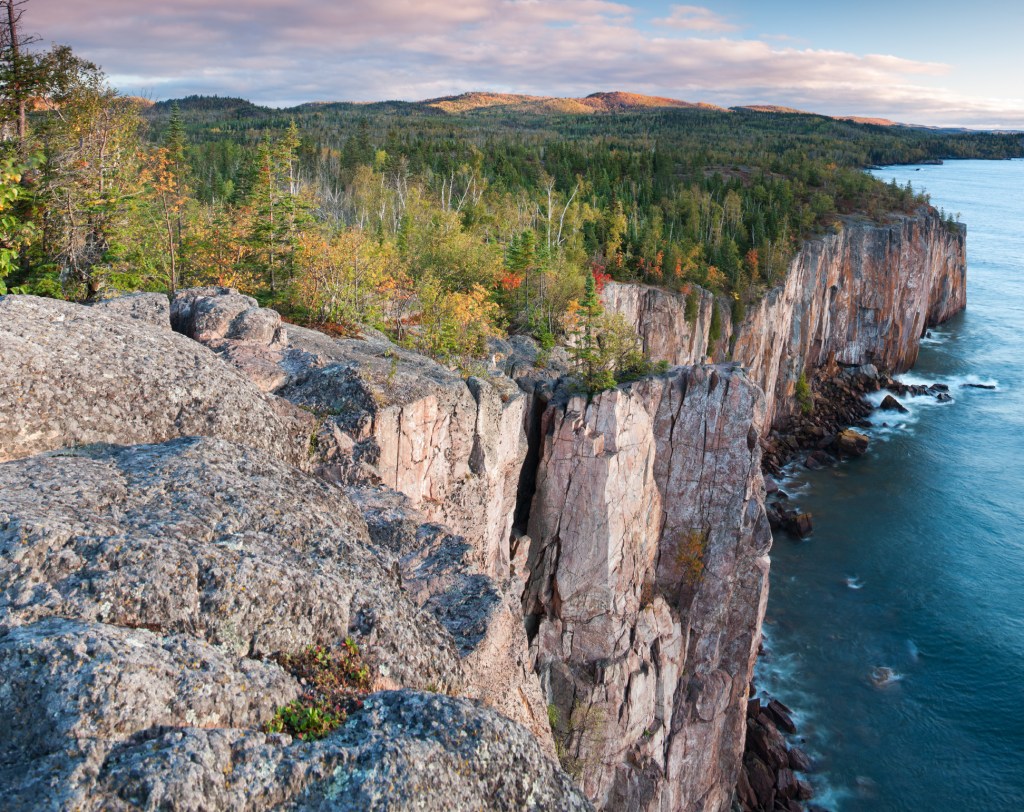
Lichen and moss of countless shades of green cling for life on misshaped boulders littering the forest floor. Dampness, the smell of earth, and decomposition fill my nostrils. I sense the open vastness of blue beyond the tree line but had yet to glimpse its true grandeur. Walking carefully now and hearing a low rumble of waves crashing far below, I expect a severe drop-off where the trees end. Closer now, I see the water’s surface stretching to the horizon with no land in sight.

As a child, I can remember the Lake’s mood changing throughout the day, sometimes wearing a shimmering silver coat, sometimes slate gray or a dark blue-green when a steady wind blew breakers against its rugged shores. Today’s surface comprises the most pleasing shade of blue, and the massive body of water is seemingly content within its confines.

Clearing the last of the trees confirmed my suspicion as the land abruptly ended, and sheer-walled cliffs dropped precariously a 100 feet or more to Superiors surface. The shoreline’s spectacular view to the North and South only revealing a tiny portion of the Great Lake’s magnificence.

Peering over the edge, I could see boulders deceptive in both size and depth scattered across its floor just beyond where the cliffs started their ascent —the clarity of the water rivaling the purest of fresh-water springs of Northern Florida.

The Lake is always conveying a sense of uncontrollable power whenever I get into proximity—the rocky shoreline and cliffs standing guard battle against gigantic waves during November gales.

The North Shore of Lake Superior from Duluth to Grand Portage is a window into an earlier, more primitive time, and Superior remains too massive and wild ever to be tamed by man.

I am sitting still on my perch at the top of the cliff, watching and listening to the most glorious of the Great Lakes. I am as always taken aback by its immense beauty, respectful of its power, and grateful for its ability to connect me to its ancient past.

The Haunting of Look-Out-Point

Ted Sanford ran his hand along the top of the low rock wall dividing his parent’s property from their neighbors. The wall, probably a hundred or more years old, built with cobblestones, was cool to the touch. It was nearly 5:00 PM, and in this part of the country, nightfall on October evenings came early. His overnight bag, already packed, Ted hoped he had not forgotten anything.

Greg Hanson, his best friend, was probably telling his planned sleepover story to his parents about now. The first phase of the plan accomplished earlier in the afternoon involved staging their bikes on the other side of the wall at the property’s back. The boy’s whole scheme involved spending the night at Look-Out-Point on Silver Lake. Today being Halloween, neither boy expected any pushback on their sleepover idea but knew the Silver Lake idea would hit a substantial roadblock.

A year older at 13, Greg was held back in sixth grade, struggled in school, and became a bit of a rabble-rouser. Ted, more academically inclined, liked Greg’s adventurous side even though he didn’t feel it always wise to go along. Taking a page from a daring Alcatraz escape in the sixties when Frank Morris fashioned a replica of his face and head to fool the guards, the boys planned to use pillows and other objects to duplicate their sleeping forms for the benefit of Ted’s parent’s. The boys escape route out Ted’s bedroom window, and down a sturdy trellis seemed foolproof.

Silver Lake, about a two-mile hike from Ted’s home, was a sizeable back-country lake with dozens of bays, inlets, and islands. Look-Out-Point, a narrow strip of land jutting into the lake, with an elevation of 30 feet or so above the water, had a grand view of the lake’s largest area of open water. The spit of land, mostly rock, and trees sloped toward the water and narrowed to only a few feet in width at its endpoint.

Like everyone else who lived in the area, the boys had heard the tale about a scorned bride perishing in the lake in the late 1800s. According to the story, she fled a local church in her wedding dress and later was spotted in a small rowboat on Silver Lake by a fisherman. She was rowing across the open water in the direction of Shank Island, one of the largest in the lake. A vicious storm came up with no warning and produced over six-foot-high waves, according to eyewitnesses. The townspeople never saw the woman or boat again.

Over the years, there had been reports of people hearing oars hitting the side of a wooden boat with nothing visible on the water. Other people reported seeing a single occupant dressed in white drifting 50 feet or so from the shoreline. Usually, the sightings occurred after a mist had formed on the water in the early morning hours. Look-Out-Point is one of several locations with reported sightings.

“Hey, Blandford,” Greg called as he hopped the fence into the backyard. Blandford, the nickname for Ted, stemmed from his reluctance to engage in dangerous or exciting activities.

“Hey Hamson,” Ted fired back. Ignoring the retort, Greg inquired if everything was in place.

Ted ticked them off, “supplies, check, bikes, check, sleepover story, check, items for stuffing under covers, check.”

“Oh, speaking of supplies, I have a surprise for you when we get to the lake,” Greg said.

“What?”

“ You got something in your ears? I just told you when we get to the lake,” Greg said, rolling his eyes.

“Alright, alright, let’s go to my room and check our supplies.”

Earlier, Ted found the tent he had used for camping with the scouts and stuffed it inside a pillowcase to bring to his room. The two spent the next hour going through provisions and considering that everything needed to be carried on their bikes and, on foot, for the last leg.

By 7:00 PM, most of the trick & treaters had finished for the evening, and Ted’s parents retired to the living room to watch TV. Deciding it was time to leave, the two boys crept out Ted’s window, across a short expanse of the roof and down the trellis on the side of the house.

A few minutes later, after making adjustments to their gear, the boys peddled the two neighborhood blocks to reach the dirt road leading to the lake. The cloudless night caused the temperature to drop rapidly after an unusually warm day for the time of year. The pair made good time on the dirt road, and within 20 minutes, had covered the two miles to the wooded trail leading to Look-Out-Point. The path, narrow and rocky, did not easily accommodate bikes, and the boys had previously planned to stash their bikes and go in on foot. Ted using his flashlight, guided the pair along the narrow path.

The trek through the woods, only a quarter of a mile in length, seemed to take longer and was more strenuous than the two-mile ride. Finally arriving at the site, they spent a few minutes in silence as the woods gave way to a splendid view of Silver Lake under a starry sky. Using the flashlight to pitch the tent, they then worked to gather wood for a fire. Finding wood in the dark proved challenging, and it took another thirty minutes before they had enough for a decent fire.

Building a fire created a cozy warmth for their campsite, and finally, with time to relax. Greg, grabbing his supplies, said, “check this out.” Ted watched as he pulled two tall cans of Budweiser from his stores along with a fresh, unopened pack of camel no-filter cigarettes.

“Holy crap,” Ted said, clearly impressed, “how d you get the smokes?”

“Stole ’em from the drugstore.”

Ted, unsure if he was kidding, decided not to pursue it but understood the difficulty of obtaining smokes at their age. The Budweiser was the only beer Greg’s dad drank, and he knew Greg had sneaked the cans from his supply.

Popping the tops and firing up a couple of smokes, they stared out at the night sky, lost in the splendor of the moment.

“Hey Blandford, you don’t believe all those stories about a ghost bride drifting around on the lake, do you?” In reality, Ted did tend to believe in the supernatural, but with the way Greg posed the question, he only managed a “yeah right.”

“Well, since this is Halloween and all, I say we bust that myth tonight,” Greg said before blowing a long stream of smoke into the night air.

“I don’t think it had anything to do with Halloween,” Ted said.

“Don’t matter if she floats around at night, and this is a spot where people have seen her; we should see her, right?” Ted wasn’t sure about the soundness of that logic but said “right,” anyway.

The boys finished their beers and smoked three more cigarettes while the fire burned down to embers. The chill of the night air drove them into their tent and eventually to sleep.

Ted, suddenly waking up, had a dire need to pee, and not wanting to leave his sleeping bag’s warmth, lay there for a few minutes wondering what time it was. Lying there, he had a slight memory of hearing a noise in the direction of the point when waking up.

Unable to wait any longer, Ted unzipped his sleeping bag enough to crawl outside the tent. Mist rising over the water covered its surface, settling into the depression of the lake between the shorelines. Ted venturing 20 feet or so down the path toward the point, stopped to relieve himself. The sound he thought he had heard earlier came again from somewhere nearer to the endpoint. It was a hollow sound like something hitting wood.

Ted could feel goosebumps raised on his arms as he stood still to listen. The sound came again, this time a series of bumps. With the stars out, the path had just enough illumination to navigate. Ted, looking back up the incline toward the tent, felt he could go a little further along the trail. After carefully walking another 50 feet down the path, he was closer to the water and found himself within the mist drifting ashore.

The sound ever closer, Ted strained to see through the dark. The land’s width here less than 20 feet, had a four to six-foot drop to the water. Slowly he crept another 20 feet until the earth became nearly even with the water. The mist coming in close intervals looked liked wispy curtains of moisture, and the bumping sound just to his right. Staring in the direction of the sound, he could make out the outline of the bow of a small boat. Too scared to turn away, he went closer until he could look down and see the rowboat was empty. He tried to reason that a fisherman had tied it to the rocky shore, but the story of the bride screamed in his mind.

Feeling a light brush on the back of his arm, Ted jerked his head sideways to see part of a dirty lace dress ragged and torn along its bottom from being dragged across the ground. Ted lurching forward, nearly lost his balance on the edge of the rocks. Looking back at the veiled figure, it stood motionless facing him. Ted, backing up to the edge of the shoreline, prayed the form would not come toward him. The mist’s curtains continued flowing in from the lake, and as each one moved between the trees, parts of the apparition drifted away until the form completely disappeared. Still mortified by what he had witnessed, Ted finally moved from the edge of the rocks and took a few steps into the wooded area. Looking back at the water, he was just in time to see the small boat with the lone figure disappear into the lake.  

Halloween on the Virginia Creeper Trail

For my Grandson Sebastian

On Halloween night, when other children are preparing for a fun evening of dressing up and going door to door collecting treats, there is a different scene playing out in Damascus, Virginia. Each year on Halloween in Damascus, shops close early, residents secure windows and doors, and parents gather their children inside close to them.

Nobody can say for sure when the phenomenon started or when it might end, or how long the residents will live in fear of Halloween night. Every year for as long as people can remember, the same horror plays out within the small community.

When darkness finally comes to Damascus’s streets on Halloween night, there is no one left outside. Nobody dares go out after dark, and what lights remain on are turned low with curtains pulled tight.

At the stroke of midnight, the bell from the town’s clocktower rings out 12 times, and as the last chime reverberates in the night air, the town’s residents hold their collective breath, listening to see if this year might be different. One second…five seconds…ten seconds pass before the shriek of the Ghost Train whistle at the summit of White Top Mountain pierces the silence.

To the huddled children, the noise sounds like a hundred witches crying in unison. The whistle is followed by a thunderous motion that trembles the earth as the Ghost Train starts its journey down the Creeper Trail at breakneck speed. According to old-timers who have seen it pass, the train has only one passenger car, rumored to hold an unpleasant cargo.

The train barrels through narrow passages and across dozens of bridges spanning the Whitetop Laurel River’s rocks and rapids. Tree branches sway widely, creeper vines and leaves scatter before it as the gray apparition moves along the path, indifferent to the fact that there are no longer rails.

Deer and small animals sensing its approach try to escape in every direction, and unfortunate tourists caught on the trail after dark tell tails of a misty gray engine with CREEPER emblazoned across its boiler. As far as anyone knows, Damascus’s old abandoned train station is the Creeper engines only stop.

The thundering gets louder and louder as the train approaches the town, and families huddled together to make sure they have accounted for all of their children.

Timmy Felder is the one exception. Timmy, a ten-year-old boy who happens to live across from the old Damascas train station on Railroad Ave, is locked inside his second-story bedroom and is lying beneath a window on the bedroom floor. Timmy is determined to find out why the ghostly engine stops each year at the abandoned Damascas station. The hardwood of Timmy’s floor is starting to vibrate from the approaching engine. Sound is tricky in the mountains, and Timmy can’t be sure when it will arrive.

A sudden gust of wind buffeted Timmy’s house, and the thunderous noise has stopped, and a long hiss that sounds like escaping steam comes from outside his window. Timmy cautiously raising his eyes even with the window sill can hardly believe what he is witnessing.

As the door slides open on the passenger car, a slimy green blob slithered down the steps and onto the rotted platform and quickly disappearing beneath the station. Next, a skeleton with a limp strolled out of the car and headed toward the town’s graveyard. The next creepy passenger, a misty ghost, floated across the street and through the walls of Mrs. Martins Bed & Breakfast. A purple and brown four-legged spotted creature came next, and it headed for the bridge spanning the river.

One after one, the creeps from the Creeper Railroad disembarked and took up residence somewhere within the town, and then as suddenly as the engine had appeared, it dissolved into the night air, and the people of Damascus had once again survived Halloween near the Creeper Trail.

The One That Got Away

Ever since Brad Johnson turned off the main highway onto the secondary road taking him into the National Forest, he kept looking into the dense foliage for a hint of blue. He knew from maps, and his friend Bobby, that there was an enormous lake hiding somewhere behind the trees.

His old Jeep, in its 19th year of service, five of them under his stewardship, was so far behaving. At one time in its life, it had been a bright red, but now more closely resembled the rusty maroon body shops use as a primer. The Jeep did not have a roof covering, which forced Brad to find shelter under bridges or other structures during rainstorms.

This new patch of road with its cracks, bumps, and depressions was a better match for the Jeep’s strengths than the endless straightaways of the interstate. The last leg of the journey, according to Bobby, would be a dirt road with switchbacks and steep drops, the type of ruggedness scripted for a Jeep.

Bobby, who had found the destination by accident when taking the scenic route back from his parent’s cabin near Lake Superior, started down the dirt road and discovered his car not up to the challenge. Abandoning it in a small clearing near the paved road, he hiked in on foot. Captivated by the beauty of the place, he made notes to be able to find the location again.

Lakes in these northern territories are so large and plentiful; locals take it for granted there will be another around the next corner. Birch Lake, a 50,000+ acre lake sparsely populated due to remoteness and lack of access roads, had all the indications of being a hidden gem.

Brad missed fishing with his Dad, who had died several years earlier. They both had loved the sport, especially fishing for Northern Pike with bright red and white Daredevil lures. Brad, like his Dad, loved everything about the outdoors, how sunlight slanted through a canopy of trees, how early fallen leaves cartwheeled down a road in an unexpected wind, and a sense of awe with each new sunrise. 

Brad saw a meadow-like clearing on his right, which Bobby had told him to look for; it was a distance marker for the turn onto the dirt road in approximately a half-mile. “The turn is easy to miss,” Bobby had said. Looking down at his gages, Brad slowed the Jeep from 50 to 40; he had not seen another car since turning off the main highway nearly 35 miles ago. Getting closer to the half-mile mark, he slowed to 20 and saw a slight break in the tree line on his right.

Making the sharp turn, he discovered a dirt road, barely the width of a car closed in on both sides with heavy pine boughs and hardwoods. A strip of grass ran between the rutted tire tracks standing nearly two feet in height. Brad slowing to a crawl, carefully navigated the tight turns as branches scraping across the Jeeps surface reminded him of fingernails on a chalkboard.

After five minutes of steadily descending toward the lake, he caught his first glimpse of blue.  The lane suddenly gave way to an opening with a glorious panoramic view of the lake—the distant shoreline just visible on the horizon. The final drop to the water’s edge was steep and rugged with exposed rock outcroppings, typical of glacier lakes in the region. Huge boulders near the shoreline randomly marched into the ever-deeper waters.

Cutting the engine, he sat still, listening to a light breeze rustling copper leaves while busy insects labored in the tall grass, and water gently lapped the shoreline. The water’s surface was glassy in the small protected cove below him, and the scene more splendid than Bobby had described.

Brad pitching his tent on the edge of the tree line, searched for firewood as the sun sank lower. Nights at this latitude often dipped into the ’50s even in the height of summer. The lonely sound of a loon drifted ashore from somewhere on the water as the setting sun cut a bright path across the lake.

With a fire started and the last bit of daylight extinguished, an incredible display of stars appeared. Brad, mesmerized by the scene, felt fortunate to be a witness to such a glorious display.

In the morning, Brad brought a small pot of water to a boil on his portable stove. Pouring the water over coffee grounds at the bottom of a French Press turned the liquid into a vibrant brown. The aroma blending with the earthy smells of his surroundings offered a welcome comfort in the coolness of daybreak.

The one-person Kayak sticking partially out the back of the Jeep was secured by a ratchet-style strap to the Jeeps roll bar. Pulling it free, he dragged it down the rocky embankment where a narrow strip of small rocks and sand at the water’s edge allowed him to load the tiny craft before launching. A suspended mist hung above the lake’s surface in the still air, adding an element of seclusion to his departure.

Fishing from a Kayak is an exercise in efficiency with only room for essentials. Brad lashing his rod and reel to the boat’s side had already pared his tackle down to just two lures, and some extra line. Now positioning himself into the small opening in the crafts center, he rocked the boat to free it from the shoreline.

There is something magical about being on the water, suspended above a mysterious world, and seeing the shoreline from a perspective only possible from the lake. The paddling was comfortable in the calm waters, and Brad smoothly alternated sides with even strokes as his muscles warmed up to the consistent motion.

He didn’t have a destination in mind; for now, just being on the water in the tiny craft was reward enough. He remembered as a kid thinking his Dad had some strategy for the places, they would choose to fish on Detroit Lake, but later found out it was just about what felt right on that particular morning.

Outside the cove, with the mist clearing, a stunning sunrise came into view on the eastern shore. Resting his paddle on the Kayaks surface, he studied the lake, looking for a place that felt right.

With daylight increasing, giant boulders on the bottom of the lake were now visible. While fascinated by the underwater scene, a substantial Northern Pike appeared between the rocks swimming in the direction of the shore. Brad stunned by the size of the fish, quickly released the fishing pole from the side of the boat. The bright Daredevil lure secured to the end of the line had its treble hook attached to one of the rigs eyelets with enough tension to cause the rod to bow slightly. Releasing the hook, Brad sent the lure sailing through the air on a quick cast toward the shore.

Winding the reel, he paused ever so often to allow the lure to sink a bit as he attempted to gain the attention of the Northern with a motion designed to mimic a smaller fish. Continuing to turn the reel, the Daredevil came back to the boat, flashing its color and silver underbelly in the clear water. Brad bringing the rod straight up with the lure dangling, arched his arm back and sent the lure flying for a second time toward the shore.

The lure sailed nearly 50 feet before hitting the surface of the water with a plop. This time as he started to reel the lure back toward the boat, he felt a jerk that nearly pulled the rig from his hands. Clutching the rod and reel tightly, he watched in amazement as the end of the rod bent a foot or more into the water and vibrated fiercely as the great Northern turned the Kayak toward the open water. Brad could not manage to turn the reel and was doing well just to hold on. And just as sudden and dramatic as the initial strike, the rod snapped straight, the line went slack, and the fish was gone.

Brad sat still in the aftermath of the struggle on the remote lake in the early morning hours with the sun barely up and realized he just experienced everything he had made the trip for in those few seconds.  

He could see an image of his Dad leaning over the side of their small aluminum fishing boat net in hand, waiting for Brad to bring the fighting fish close enough to the boat to be scooped into the net. He had an overwhelming feeling of contentment at that moment and a renewed faith in the future.

Missing

The sprawling abandoned complex of buildings covering nearly a mile of land close-in to downtown runs adjacent to a road Dan Banks travels every day to work. Dan, an accountant, works in a high rise in the city and is an amateur photographer in his spare time.

He loves photographing old houses and farms in the countryside where people have left for whatever reason. He is fascinated with the moment in time when a home ceases to exist as living space and only objects left behind can provide clues about the former occupants. There might be a pot left on a stove, a random chair in an empty room, or important-looking papers, somehow losing their significance. Usually, the photographs he captures beg more questions than answers.

Today is Saturday, and the refreshing early fall weather prompted Dan to open his car windows. He is traveling his familiar route toward work to drop a folder at his office and then planned to indulge in his hobby of photography.

Waiting for the light to change at the last intersection before entering the downtown proper, Dan gazed across at one of the brick structures within the abandoned complex. He understood the buildings close- in to the city are some of the oldest, dating to the early 1800s—the whole complex at one time comprising the state’s mental health facilities. The buildings on the sprawling site look like an architectural timeline of styles stopping sometime in the 1970s.

After leaving his office, instead of going straight out of town, Dan turned right into the old complex, thinking there might be an opportunity to capture some images of the empty buildings. Passing the imposing brick structures on his right, Dan turned down a neglected road before slowing to a stop in front of an unusual building catching his eye.

There is a covered walkway running across the front of the building, with weeds and tall grass growing from every crack. The building’s roofline with five arches, Dan imagines is mimicked on the inside, and probably covers open bays. Walking up to a small section of a wrought iron fence, he can see a vast central courtyard closed in on all sides. If he shot from here, the pictures wouldn’t do justice to the vastness and desolation of the space. The perfect spot looked to be from the interior.

Walking from the front to the right side of the building, Dan could see three of the other sections forming the courtyard. These sections were two stories in height, and reminded him of an old-style hotel. For some reason, the second-story windows were not boarded, and a lot of the panes were broken. A curtain fluttering in the wind through one broken window caught Dan’s eye, and focusing his lens on the spot, he took a series of rapid shots.

Adjusting his telephoto lens to its maximum focal length, Dan tried to see into the interior of the room. A gust of wind sweeping across the courtyard pushed the curtain into the room, lifting it several feet in the air. Dan, jerking backward, nearly dropped his camera, when for a split second, the wrinkled face of an old woman appeared in his viewfinder. Shaken from the image, he quickly brought the camera back to his eye, trying to refocus on the spot. The wind had died down; he could only see the curtain behind the broken glass.

“What the hell was that,” Dan said in a low voice. He was second-guessing what he had just seen and tried to reason other explanations for the image. His first instinct was to leave, but the thought of someone needing help held him in place. He didn’t love the idea of trying to search hallways and rooms inside the old building but thought he should try.

Hooking his camera strap onto an iron picket, he eased it down, so it hung on the inside. Looking across the front of the building, he made sure no one was about, before carefully scaling the fence. Once inside, he removed the camera strap and hung it around his neck. Staying on the interior sidewalk near the structure, he was overwhelmed with possible shots within the courtyard.

Reaching the far side, he was in front of the building where the woman had appeared. Standing still, he listened for sounds of movement, the breeze through the overgrown courtyard was all he could hear. A previous visitor had removed the boards covering a ground floor window opening that was nearly his height, and stepping through; he found walls covered in graffiti and the smell of mold and neglect. The room was empty of furniture, but in the hallway, random broken furniture, old bed springs, and garbage lay strewn across the floor.

Spotting a staircase at the end of the hall, he picked his way through the discarded objects and quietly ascended two flights to the second level. He had made a mental note that the room was the third from the corner, and now standing at the top of the stairs, saw its door stood partially open.

This hallway had a different feel from the stuffiness of the first level; here, the space had a creepier livelier feel with air currents and bumping, clicking noises coming from some of the rooms. Dan, unsure of what he would do if he encountered someone, crept cautiously toward the open door.

Reaching the opening, he heard a swooshing sound from within, the bottom of the curtain sweeping across the vinyl floor. Dan reaching out, pushed the door inward, and watched as it swung open to reveal an empty room. There was no furniture, no artwork on the wall, nothing in the space he could have mistaken for the image. There were also no signs of anyone recently inhabiting the room.

Going back out into the hall, Dan looked down the long corridor at the dozens of rooms on either side. There was no way he was going to find someone in here, especially if they wished to remain hidden. Pulling the door shut, he noticed its numbers were missing, but with the difference in the coloration of the wood, he could see it was 207.

Later that night in his home office, Dan searched online for information about the facility. His best source, digitally archived newspapers, proved valuable. He found an article dated from 1976 with a picture of the facility saying it was soon to close for good. A few weeks later, the place was back in the news with a headline about one of its residents who had gone missing. The director explaining the building was secure, but a determined resident could find a way out. The remaining residents would be moving by the end of the week, and the building shuttered for good.

An hour later, Dan, tracked down the police report for the given date in public records and what he read made the hair stand up on his neck and arms. Missing, Marcy Keary, a 30-year-old white female whose last known whereabouts was as a resident in room 207 of the center for women’s mental health on Blackwell Street near downtown.