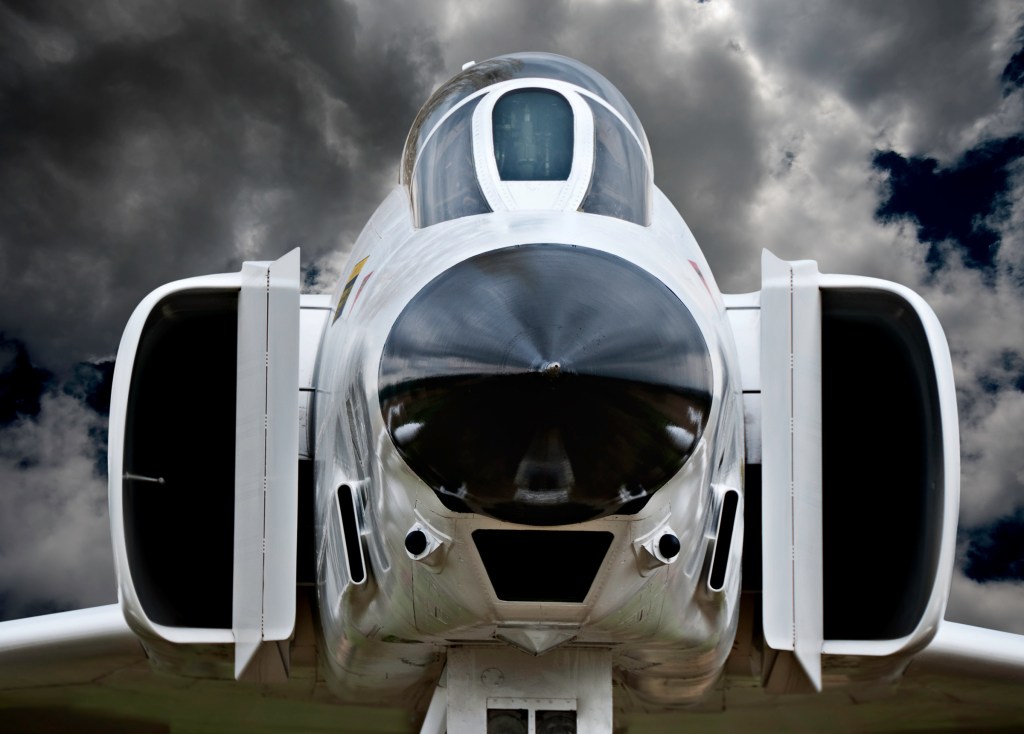
When I saw the flight line for the first time with its artificially lit surfaces and the F4 fighter jets perfectly aligned in three rows stretching the distance of a city block, I was in awe. Four double-wide trailers stationed behind the jets sat evenly spaced over the same distance. The jets, facing away from the trailers, were parked at a 20-degree angle. The trailers housed the maintenance crews responsible for keeping the jets flying, and a dispatch coordinated all of their activity.
I was eighteen years old in 1977 and had just arrived at MacDill Air Force Base in Tampa, Florida. MacDill was a pilot training base in those days, and as I was soon to find out that meant a lot of missions flown, and around the clock maintenance to keep all those fighters in the air. MacDill was my first assignment after basic, and a 13-week training school in Denver, Colorado.
Standing on the tarmac next to the jets for the first time, I found myself wondering how something so heavy with such a small wingspan could ever achieve flight. Later, when witnessing for the first time a group of four thundering down the runway in pairs, I understood. The two enormous engines propelled the craft more like a rocket and flight appeared to be achieved through sheer brute force of overwhelming thrust; with afterburner flames lighting up the night sky. I became thoroughly impressed by the brave pilots who sat atop those engines and rode those beasts into the sky.
The incoming recruits arriving on the base allowed troops with more seniority an opportunity for better shifts, with the newest arrivals relegated to swing-shift or mid-shift. I started on mid-shift and tried to get accustomed to my strange new environment.
The flight line was a place in constant motion and endless noise. JP4, the jet fuel used by the fighters hung heavy in the air. There were gas-powered lighting units trained on the sides of jets receiving maintenance, creating islands of light brighter than daytime. Huge custom generators used to simulate voltages achieved during flight, let ground crews operationally check systems. The plug from the generator that attached to the bottom of the jet was as thick as a person’s leg, and when cranking up, sounded similar to a jet engine, their noise adding to the chaos of the place. In addition to all the people on the tarmac, a constant parade of support vans, towing vehicles, security pickups, and countless other equipment zigzagged its way between the fighters.
It was a dangerous environment filled with sharp surfaces, low clearances, heavy equipment, dangerous materials, heat, and fatigue. I could feel heat stored in the thick cement of the tarmac being released back into the night air after an exceptionally hot summer day. The base, surrounded by the water of Tampa Bay, gave the air a salty brackish smell that was more unpleasant at low tide. Heat lightning within thunderheads usually over the gulf provided spectacular light shows.
The fighters sitting motionless waited through the night as crews scurried under, around, and inside, checking, and double-checking their systems. Each night was a choreographed dance of experts in every discipline, fighting the clock for when the pilots arrived, and it was time to fly.
All procedures in and around the jets required a checklist, and each task required a specific order in which steps within the task were carried out. The checklists ensured all steps were completed and kept the maintenance crews safe from preventable mishaps.
I was the number four man on a weapons crew of four men. One of my main jobs was to drive a bomb lift vehicle used to load weapons onto the fighter. The vehicle, affectionately known as the Jammer, was essentially a forklift built in a low horizontal fashion that enabled it to slide beneath the low clearance of a fighter jets belly. The table of the Jammer had hydraulic controls for fine adjustments and allowed the crew chief to guide the munition precisely into its position on the fighter. Driving the Jammer underneath the jet to load the larger air-to-ground missiles was challenging for someone of my height, and I would have to duck my head down nearly even with the Jammers steering wheel when loading the missiles at the rear of the jet.
It was all pretty overwhelming at first and later became the norm as I spent the next eight years of my life working in an around fighter jets. Hundreds of pilots cycled through training during that time, and many probably went on to fight in Desert Storm. Within that loud, noisy, dangerous environment, there was also beauty in the gentle rains when reflected just right reminded me of a Minnesota snowfall. Or the incredible sunrises, and spectacular thunderstorms. And at the end of the shift, arriving home exhausted from the night’s work, seeing my baby daughter Lana who was always happy to see me come home.
 Joseph Benedict Blog